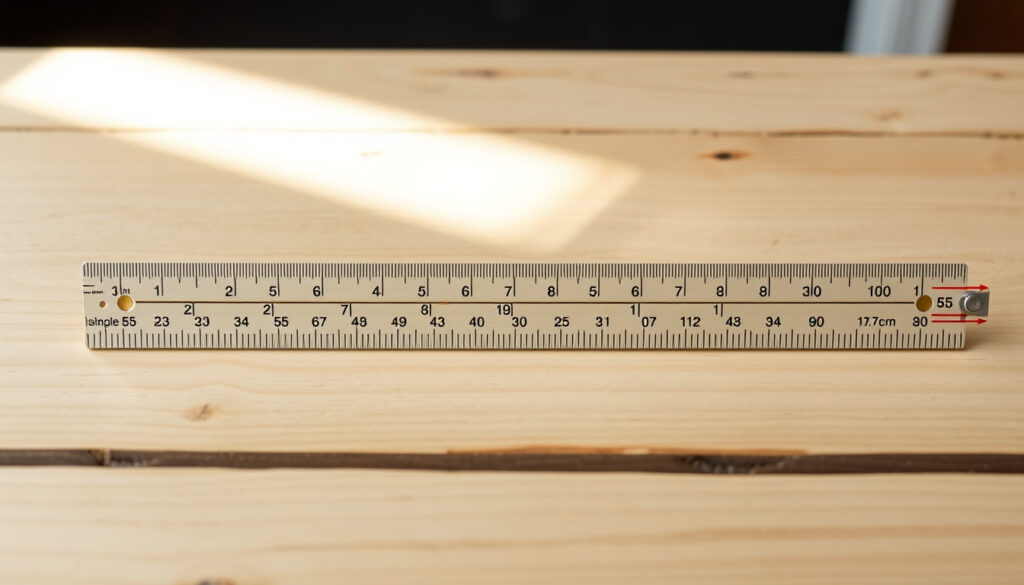
55 Inches in CM – Exact Conversion to 139.7 cm
55 inches equals exactly 139.7 centimeters. This value is not approximate—it results from the internationally standardized conversion factor where 1 inch = 2.54 cm exactly.
How Many CM Is 55 Inches?
When converting 55 inches to centimeters, the answer is straightforward: 55 inches = 139.7 cm. This precise conversion matters across numerous applications, from television screen measurements to engineering specifications. The calculation follows a standardized formula established by international agreement, ensuring consistency regardless of where or how the measurement is used.
Understanding this conversion becomes essential when working across metric and imperial measurement systems. Many consumer products—particularly electronics—list dimensions in inches for global markets, yet metric measurements often appear in technical documentation or international shipping contexts. The difference between the exact value and rounded approximations can matter in professional settings where precision counts.
This article examines the exact conversion, the formula behind it, verification methods, and practical applications including common TV screen sizes. All information derives from established international standards and authoritative sources in metrology.
Quick Conversion Overview
| Metric | Imperial | Value | Notes |
|---|---|---|---|
| Length | 55 inches | 139.7 cm | Exact conversion |
| Conversion factor | 1 inch | 2.54 cm | International standard |
| Approximation | 55 inches | 140 cm | Common rounded use |
Key Points to Remember
- Precise value: 55 × 2.54 = 139.7 cm
- Common rounding: 140 cm for casual contexts
- TV usage: diagonal measurement of the display panel
- International standard: 1 inch = 2.54 cm exact
- Defined by International Yard and Pound Agreement of 1959
- Adopted by BIPM and endorsed by NIST
The value 139.7 cm is the exact result of multiplying 55 by the internationally standardized factor of 2.54. No empirical measurement is involved—the factor is fixed by international treaty for precise equivalence between imperial and metric units.
Is 55 Inches Exactly 140 CM?
The short answer is no—55 inches is not exactly 140 centimeters. The exact conversion yields 139.7 cm, which differs by 0.3 cm (3 millimeters). This distinction matters in contexts requiring precision, though rounded values commonly appear in everyday situations.
Understanding the Difference
The discrepancy between 139.7 cm and 140 cm amounts to approximately 2.1% of the total rounding error possible when converting inches to centimeters. While this margin seems negligible for casual purposes, it becomes significant in manufacturing tolerances, architectural specifications, or scientific applications where tight precision is required.
The value 140 cm functions as a convenient approximation widely used in retail, media descriptions, and general conversation. When someone refers to a “55-inch screen,” they typically mean the diagonal measurement specified by manufacturers, which translates to exactly 139.7 cm regardless of how the value is rounded in marketing materials.
Conversion Verification
To verify the conversion manually: multiply 55 by 2.54, yielding 139.7 cm. This calculation requires no special tools—the factor of 2.54 is constant and legally defined, not derived from physical measurement. The International Bureau of Weights and Measures maintains this standard internationally.
For reverse conversion: 140 cm equals approximately 55.12 inches—not a round number. This asymmetry confirms why the exact value (139.7 cm) matters when precision is needed rather than convenience.
How to Convert Inches to CM (Formula)
The conversion formula from inches to centimeters follows a simple multiplication: centimeters = inches × 2.54. This factor is not approximate or rounded—it is precisely defined by international agreement as exactly 2.54 centimeters per inch.
The Mathematical Process
For converting 55 inches specifically, the calculation proceeds as follows:
- Starting value: 55 inches
- Multiply by conversion factor: 55 × 2.54
- Result: 139.7 centimeters
The calculation works identically in reverse: dividing centimeters by 2.54 yields inches. This bidirectional consistency makes the formula reliable for any conversion between the two units.
Historical Derivation of the Factor
The factor 2.54 has roots in historical measurement systems. Before 1959, the US inch was defined as exactly 25.40005 millimeters, while British and Commonwealth measurements used slightly different values. The International Yard and Pound Agreement of 1959 standardized the inch at exactly 25.4 millimeters (or 2.54 centimeters) across participating nations including the United States, United Kingdom, Canada, Australia, New Zealand, and South Africa.
This standardization eliminated minor discrepancies that had existed between measurement systems. The value was chosen not through physical measurement but as a legal definition ensuring consistent equivalence between imperial and metric units.
55 Inch TV Size in CM and Common Uses
The television industry exemplifies why understanding the 55-inch to centimeter conversion matters practically. When manufacturers describe a television as “55 inches,” they refer to the diagonal measurement of the visible display panel, excluding bezels or frames.
TV Diagonal Measurements
A 55-inch television screen measures exactly 139.7 centimeters along its diagonal. This diagonal specification represents the distance between opposite corners of the active display area, regardless of the screen’s aspect ratio or physical dimensions.
The television industry continues using inches for marketing and specifications globally, even in countries where the metric system dominates daily life. Understanding the conversion helps consumers compare screen sizes accurately when shopping internationally or reading specifications from different markets.
Related Screen Sizes
| Screen Size (inches) | Diagonal (cm) | Common Usage |
|---|---|---|
| 54 inches | 137.16 cm | Compact home theater |
| 55 inches | 139.7 cm | Standard living room TV |
| 56 inches | 142.24 cm | Mid-size displays |
| 57 inches | 144.78 cm | Large format options |
| 58 inches | 147.32 cm | Premium displays |
For those working with height or other linear measurements, converting between systems becomes equally important. Understanding 165cm in Feet and Inches provides useful context for metric-imperial conversions generally.
Additional Equivalents
Beyond centimeters, 55 inches converts to several other useful units:
- 1,397 millimeters
- 1.397 meters
- 4 feet 7 inches (when expressed in feet and remaining inches)
Weight conversions follow similar principles. Those interested in metric-imperial equivalence might find our 60 kg to lbs conversion a useful reference alongside this length conversion guide.
When comparing television sizes or planning placement, remember that listed screen sizes refer to diagonal measurements. Physical TV dimensions (width and height) vary based on aspect ratio, bezel thickness, and stand design. Always check width and height specifications separately if cabinet or wall space is limited.
Understanding the Precision of the Conversion
The conversion of 55 inches to 139.7 centimeters carries 100% certainty because the relationship between inches and centimeters is defined, not measured. The factor 2.54 cm per inch is established by international treaty and carries no uncertainty in scientific or commercial contexts.
What Is Established
The mathematical relationship is absolute: 55 multiplied by 2.54 yields exactly 139.7. This calculation requires no rounding when expressed to one decimal place. The precision level depends only on how many decimal places the application requires—139.70 cm, 139.700 cm, and 139.7000 cm all represent the same exact value.
Common Misconceptions
Some sources suggest 55 inches equals approximately 140 cm, which rounds the value for convenience. While this approximation serves everyday purposes, it introduces a 0.3 cm discrepancy that compounds in technical applications. Professional contexts involving engineering specifications, manufacturing tolerances, or scientific measurements should always use the exact value.
Why 2.54? The Origins of the Conversion Factor
The conversion factor 2.54 centimeters per inch derives from historical decisions made during the development of modern measurement systems. Understanding its origins provides context for why precise conversion matters.
Historical Evolution
The inch was historically variable, with definitions based on physical objects—such as the length of barley grains or the thumb of a monarch. These inconsistent definitions created problems for international trade and technical communication. The metric system, developed during the French Revolution, offered a logical alternative based on natural constants, but bridging the two systems required a fixed equivalence.
In 1959, the International Yard and Pound Agreement resolved this by legally defining the inch at exactly 25.4 millimeters. This value eliminated the previous 0.00005 millimeter discrepancy that had existed between American and British inch measurements. The defined relationship means conversions between the systems carry no measurement uncertainty—they are arithmetic, not physical comparisons.
Modern Standards Bodies
The National Institute of Standards and Technology maintains official definitions for imperial units in the United States, while the International Bureau of Weights and Measures oversees the metric system internationally. Both organizations recognize the 2.54 cm per inch factor as exact and legally binding under international agreement.
This standardization benefits numerous industries. Consumer electronics rely on consistent measurements for global product development. Shipping and logistics depend on accurate dimension conversions for container loading and international freight. Medical and scientific applications require precision for research replication and equipment compatibility.
According to the NIST definition, 1 inch = 25.4 mm exactly. This precise definition applies to all imperial-metric conversions, including the 55-inch measurement discussed throughout this article.
Official Standards and References
Several authoritative bodies define and maintain the standards for length conversions between imperial and metric units. Understanding these sources helps verify conversion accuracy.
The inch is defined as exactly 25.4 millimeters (2.54 centimeters) by international agreement. This definition, established in 1959, provides the mathematical basis for all inch-to-centimeter conversions used worldwide.
The International Yard and Pound Agreement of 1959 created the framework for consistent measurement between imperial and metric systems. Participating nations included the United States, United Kingdom, Canada, Australia, New Zealand, and South Africa. This treaty ensures that measurements remain consistent across international borders.
For those seeking verification of specific conversions, multiple conversion calculators exist to confirm calculations. These tools apply the standardized formula programmatically, eliminating human error in manual calculation.
Quick Reference Summary
To summarize the key conversion: 55 inches equals exactly 139.7 centimeters. This value results from multiplying 55 by the internationally standardized factor of 2.54 cm per inch. For practical purposes, 140 cm serves as a commonly rounded approximation, though the exact value is 139.7 cm.
Understanding this conversion matters for numerous applications, from evaluating television screen sizes to comparing international product specifications. The conversion carries no uncertainty because the relationship between inches and centimeters is legally defined rather than measured.
Expand Full Conversion Reference
| Input | Output | Notes |
|---|---|---|
| 55 inches | 139.7 cm | Exact conversion |
| 55 inches | 1,397 mm | Millimeter equivalent |
| 55 inches | 1.397 m | Meter equivalent |
| 55 inches | 4 ft 7 in | Feet and inches |
Frequently Asked Questions
Why do televisions use inches for screen measurements?
The television industry standardized on diagonal inch measurements historically, and the convention persists globally for marketing consistency. Despite the metric system being official in most countries, the inch-based system remains entrenched in consumer electronics specifications.
How many inches is 140 cm?
140 cm equals approximately 55.12 inches. This reverse conversion shows that 140 cm is slightly larger than 55 inches (by about 0.12 inches or 3 millimeters), confirming that the two values are not equivalent.
Is 55 inches 140 cm rounded?
Yes. While 55 inches exactly equals 139.7 cm, many contexts round this to 140 cm for convenience. The 0.3 cm difference (3 millimeters) seems negligible in casual use but matters in precision applications.
What is the formula for converting inches to centimeters?
The formula is: centimeters = inches × 2.54. This constant factor is internationally defined, not approximately measured, ensuring precise conversions every time.
Why use inches versus centimeters?
Some industries and countries maintain imperial units for historical and cultural reasons. The United States primarily uses imperial measurements, while most other nations use metric. International trade requires conversions between systems, making understanding both essential.
Are there other common TV sizes near 55 inches?
Common adjacent sizes include 54 inches (137.16 cm), 56 inches (142.24 cm), 57 inches (144.78 cm), and 58 inches (147.32 cm). Each represents a standard manufacturer size with corresponding metric equivalents.
Does the conversion factor ever change?
The conversion factor of 2.54 cm per inch is legally defined and extremely stable. International standards bodies maintain this value as a fixed definition rather than a measured quantity, so it cannot drift or change through calibration.
What tools verify these conversions?
Official conversion calculators from metrology organizations and standards bodies apply the defined formula programmatically. The conversion tools use the same arithmetic as manual calculation, simply automating the process.
More related posts
 Russell Tovey Movies and TV Shows – Complete Filmography Guide
 Met Office Rainfall Radar: How It Works and How to Use It
 Eddie Kadi: Biography, Age, Family, Strictly Come Dancing 2023
 Bone Profile Blood Test: What It Tests, Results & Normal Range
 Pull and Bear Discount Code: 10% Off + 50% Deals 2026
 British Gas Meter Reading: Complete Submission Guide
 Matthew Broderick: Biography, Accident, and Irish Home
