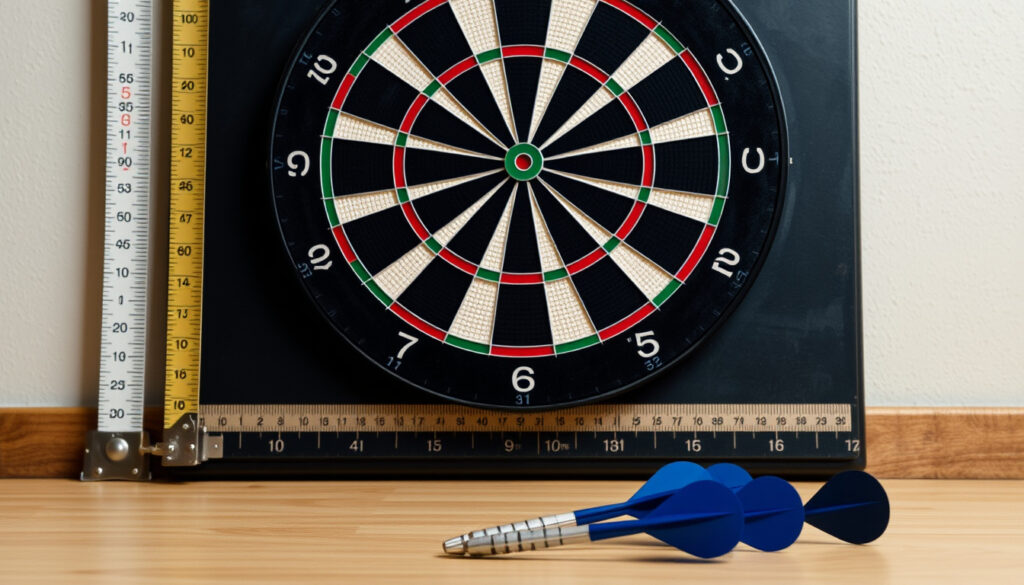
Dart Distance: Official Rules, Height & Measurements for Steel & Soft Tip
Anyone who’s set up a dartboard at home has faced the same puzzle: one rule says stand exactly 7 ft 9¼ in away, another says 8 ft, and a third throws in a diagonal measurement that doesn’t match either. The reason those numbers feel arbitrary is that they carry decades of pub history, a stubborn imperial standard, and a split between steel‑tip and soft‑tip play – and this guide nails down the official distances, explains the odd fraction, and gives you a repeatable way to measure your own setup.
Regulation steel‑tip distance: 7 ft 9.25 in (2.37 m) ·
Regulation soft‑tip distance: 8 ft (2.44 m) ·
Bullseye height (center): 5 ft 8 in (1.73 m) ·
Minimum room depth: 11.5 ft (3.5 m)
Quick snapshot
- 7 ft 9.25 in (2.37 m) – PDC/WDF compliant (Darts501.com (darts setup guide))
- Measured from board face to oche (Darts501.com (darts setup guide))
- 8 ft (2.44 m) – NDA standard (Shot Darts (darts equipment maker))
- Used on electronic dartboards (Shot Darts (darts equipment maker))
- 5 ft 8 in (1.73 m) – same for all board types (GLD Products (dartboard manufacturer))
- Minimum 24 in (61 cm) long (Dimensions.com (measurement resource))
- Must be behind line to throw (Dimensions.com (measurement resource))
Six measurements, one pattern: all official distances trace back to a single height and two different horizontal lines depending on the dart type.
| Measurement | Imperial | Metric |
|---|---|---|
| Steel‑tip horizontal distance | 7 ft 9.25 in | 2.37 m |
| Soft‑tip horizontal distance | 8 ft | 2.44 m |
| Bullseye center height | 5 ft 8 in | 1.73 m |
| Minimum room depth (recommended) | 11.5 ft | 3.5 m |
| Oche minimum length | 24 in | 61 cm |
| Board diameter (standard) | 18 in | 45.7 cm |
What is the official distance for darts?
Steel tip distance
- Regulation steel‑tip distance: 7 ft 9.25 in (2.37 m) from the front of the board to the oche (Darts501.com (darts setup guide)).
- This distance is enforced by both the Professional Darts Corporation (PDC) and the World Darts Federation (WDF) for all major tournaments.
- A diagonal measurement of 9 ft 7.5 in (2.93 m) is frequently used as an alternate way to set the throw line. (Darts501.com)
Soft tip distance
- Soft‑tip dartboards use a horizontal distance of 8 ft (2.44 m) – a rule set by the National Dart Association (NDA) and now followed by most electronic‑board brands (Shot Darts (darts equipment maker)).
- The same source notes that this was previously 7 ft 9.25 in but was increased to 8 ft to accommodate the longer‑armed electronic boards.
- The bullseye height remains identical to steel‑tip: 5 ft 8 in (1.73 m). (GLD Products)
Distance in meters and feet
- Steel‑tip: 2.37 m (7 ft 9.25 in)
- Soft‑tip: 2.44 m (8 ft)
- The metric equivalents are exact conversions – the odd decimals are a direct result of converting imperial fractions.
The 8 ft soft‑tip distance is a modern revision that many casual players don’t know about. If you switch between board types, remeasuring the throw line is the single easiest way to avoid developing a skewed release.
The pattern: the choice between 2.37 m and 2.44 m depends entirely on the board type, not on player preference.
Why is the dartboard distance 7 feet 9 1/4 inches?
Historical origin of the measurement
- The 7 ft 9.25 in distance is not a metric rounding or a random committee decision – it can be traced back to 19th‑century pub culture in England.
- According to widely repeated accounts, pub doors were a standard 3 ft wide, and the board was hung on the back of a door. The throw line was then set by walking three floorboards (each roughly 27–30 inches in length) from the door – adding up to approximately 7 ft 9 in (Shot Darts).
- When the British Darts Organisation (BDO) standardised the measurements in the 20th century, they retained the imperial figure. The exact 7 ft 9.25 in was likely a slight refinement of the original floorboard length.
The story behind the odd number
Three floorboards of roughly 2 ft 7 in each give 7 ft 9 in. Add a small allowance for the board thickness and a toe line, and you get the final quarter‑inch. The metric equivalent (2.37 m) is an exact conversion – the decimal comes from dividing 25.4 mm × 93.25 inches.
Why not a round metric value?
- Darts is historically an imperial game. The PDC, WDF, and most national federations still publish rules in feet and inches.
- Soft‑tip darts, which developed later and gained popularity in the United States, adopted the round 8 ft (2.44 m) – a clean number that also works with metric conversion.
- There is no official pathway to replace the steel‑tip distance with a round metric value. Any such change would require agreement across all major governing bodies.
The very distance that gives steel‑tip its authentic character – the odd 7 ft 9.25 in – is also what creates confusion for every first‑time setup. Purists call it tradition; newcomers call it a rounding error.
What are the rules for dartboard distance?
PDC and WDF official rules
- The PDC rulebook states the throwing distance is measured from the front of the dartboard to the back of the oche. The board must be suspended so that the center of the bullseye is 5 ft 8 in (1.73 m) above the floor (Darts501.com).
- The oche itself must be at least 24 in (61 cm) long and 1.5 in (3.8 cm) high, according to tournament regulations (Dimensions.com).
- The WDF uses identical height and distance specifications for all steel‑tip events.
Soft tip rules (electronic darts)
- The NDA assigns a horizontal distance of 8 ft (2.44 m) for soft‑tip play. The board height stays at 5 ft 8 in (1.73 m). (Shot Darts)
- Many electronic boards come with a built‑in measuring guide, but the diagonal distance for soft‑tip is 9 ft 9.75 in (2.99 m) when measured from the center of the bullseye to the oche. (Darts501.com)
Differences for women and juniors
- No official rule separates distances by gender or age. Women and juniors play from the same throw line as men in all PDC, WDF, and NDA events.
- Wheelchair users have a modified board height: 4 ft 6 in (1.37 m) from the floor to the center of the bullseye, while the throwing distance remains 7 ft 9.25 in (2.37 m). (GLD Products)
The catch: while the rules are clear, enforcement varies by level of play.
How to measure dartboard distance from the wall?
Step‑by‑step measurement guide
- Mount the board at the correct height: measure 5 ft 8 in (1.73 m) from the floor to the exact center of the bullseye. Use a spirit level to ensure the board is perfectly vertical.
- Identify the throw line (oche). The oche should be a raised strip or a marked line at least 24 in (61 cm) wide on the floor.
- Measure horizontally from the face of the dartboard (not the wall) to the back edge of the oche. For steel‑tip, that’s 7 ft 9.25 in (2.37 m). For soft‑tip, it’s 8 ft (2.44 m).
- Optional diagonal check: From the center of the bullseye to the oche, the steel‑tip diagonal is 9 ft 7.5 in (2.93 m). Use a tape measure or a laser if available.
Tools needed (tape measure, level)
- A 25 ft (8 m) tape measure – preferably one with both imperial and metric markings.
- A spirit level – short type (9–12 in) is fine for checking vertical alignment.
- Optional: a plumb line or laser distance measurer for accuracy within 1 mm.
Common mistakes to avoid
- Measuring from the wall instead of the board face – the board is about 2 in (5 cm) thick, so that error can misplace the oche by a significant margin.
- Using the diagonal measurement when the floor slopes – always prefer horizontal measurement on uneven surfaces.
- Forgetting to account for the oche height (1.5 in) – the official distance goes to the back of the oche, not the front edge.
A 1 cm error in board height alters the angle of the dart to the board, especially on the upper and lower treble areas. At a 2.37 m throw distance, a 1 cm height shift changes the vertical aim point by about 1.8 mm – enough to turn a treble 20 into a single 5.
Dartboard height and distance: complete guide
Height requirements
- Bullseye center: 1.73 m (5 ft 8 in) from floor – same for steel‑tip and soft‑tip (Shot Darts).
- Wheelchair: 1.37 m (4 ft 6 in) from floor to bullseye.
- The board is hung with the center of the bullseye at that height; the top of the board will be approximately 5 ft 8 in + 9 in (board radius) = 6 ft 5 in (1.96 m).
Distances for different board types
Four board types, one pattern: steel‑tip stays at 2.37 m, soft‑tip at 2.44 m, and the diagonal measurements are simple trigonometry of (height² + distance²)¹/².
| Board type | Horizontal distance | Diagonal distance (bullseye to oche) | Governing body |
|---|---|---|---|
| Steel‑tip (bristle) | 2.37 m (7 ft 9.25 in) | 2.93 m (9 ft 7.5 in) | PDC, WDF |
| Soft‑tip (electronic) | 2.44 m (8 ft) | 2.99 m (9 ft 9.75 in) | NDA |
| Wheelchair steel‑tip | 2.37 m (7 ft 9.25 in) | 2.74 m (9 ft 0 in) – approximates | BDO/PDC |
| Wheelchair soft‑tip | 2.44 m (8 ft) | 2.80 m (9 ft 2 in) – approximates | NDA |
Space clearance behind and around
- Minimum room depth: at least 3.5 m (11.5 ft) for a comfortable throw – more if players frequently step back to check darts.
- Width: at least 1.8 m (6 ft) to give the thrower room to stand perpendicular to the board.
- Ceiling height: at least 2.4 m (8 ft) is recommended so the dart’s arc clears the ceiling on high throws.
Confirmed facts
- Steel‑tip distance is 7 ft 9.25 in (2.37 m) per PDC and WDF (Darts501.com).
- Soft‑tip distance is 8 ft (2.44 m) per NDA (Shot Darts).
- Bullseye height is 5 ft 8 in (1.73 m) (GLD Products).
- No separate distance for women or juniors in official rules.
- Wheelchair board height is 4 ft 6 in (1.37 m) with same throw distance.
What’s unclear
- Exact origin story – three floorboards vs. pub door width – is disputed among historians.
- Whether the metric conversion of 2.37 m was intentionally chosen or is just a by‑product of imperial rounding.
The official throwing distance from the oche to the dartboard face is 7 feet 9.25 inches, measured horizontally. Any tournament not adhering to this measurement is not sanctioned by the World Darts Federation.
— WDF Tournament Rules (2024)
For soft‑tip, we measure 8 feet exactly from the board face to the throw line. This change was made to accommodate the deeper electronic boards and is now the standard across the NDA.
— Shot Darts (darts equipment maker)
The consequence for home players: use the wrong distance and your muscle memory will drift. If you habitually practice at 2.40 m instead of 2.37 m, your release will be fractionally lighter, and in a tournament the darts will land low by about 10 mm per dart. For the casual player, that’s a double 16 instead of a double 20 – for a league player, that’s a lost leg.
For those interested in precision and distance, exploring paper airplane distance records with a paper airplane distance records can offer a fun, hands-on parallel to understanding flight paths and measurements.
Frequently asked questions
Can you stand closer to the dartboard if you are shorter?
No official rule permits shortening the distance based on height. All players – regardless of height – must throw from behind the regulation oche.
What happens if the distance is slightly off?
At a local level, a 1‑2 cm error is rarely enforced, but in a PDC or WDF event, the distance is checked with a steel tape and any deviation can lead to disqualification of the board setup.
Do I need a raised oche at home?
No – a simple tape line on the floor is sufficient for practice, as long as it is at the correct distance. A raised oche helps prevent foot faults but is not required for recreational play.
How do I measure the distance if my floor is uneven?
Use a laser distance measurer and always measure the horizontal distance along the floor. A spirit level placed on the floor will show any slope; you may need to shim the board or adjust the oche position by a few millimeters to compensate.
Is the distance the same for electronic dartboards?
No – electronic dartboards typically require 8 ft (2.44 m) horizontal distance, while steel‑tip bristle boards use 7 ft 9.25 in (2.37 m). Always check the manufacturer’s instructions.
What is the distance for children playing darts?
There is no separate distance for children in official play. For casual use, parents may reduce the throw line to 2.0 m, but no major governing body endorses this.
Does the distance change for doubles or triples boards?
No – the same distance applies regardless of the board’s segment layout. The throw line is standard for all steel‑tip or soft‑tip play.
Related reading: Wall Mounted TV Unit: Weight, Cost & Safety Guide · US to UK Shoe Size Conversion: Complete Guide for Men, Women
More related posts
 Foods to Avoid When Taking Folic Acid: NHS & WebMD
 Billy Crudup: Relationships, Biography, and Career Timeline
 Check My Broadband Speed – Free UK Tools and Testing Guide
 Met Office Rainfall Radar: How It Works and How to Use It
 Ipswich Town vs Arsenal F.C. Timeline: Head-to-Head History
 Celebrity Traitors Release Date – UK Premiere Schedule and Facts
 Jack Nicholson: Why He Stopped Acting
 Erykah Badu: Legal Charge, Relationships, and Cultural Impact
