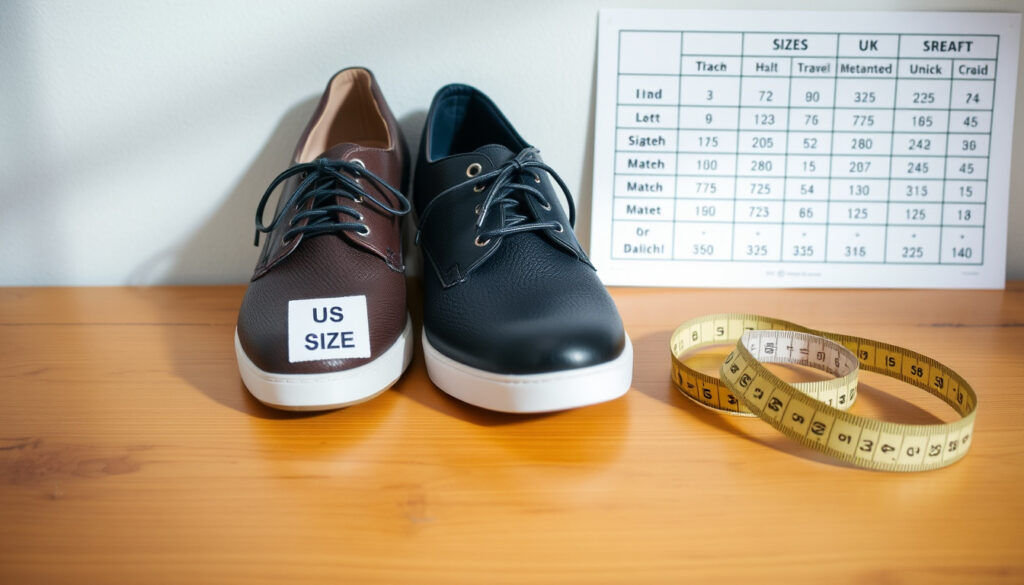
US to UK Shoe Size Conversion: Complete Guide for Men, Women
Anyone who’s ever ordered shoes online only to find they don’t fit knows the sinking feeling of a size mismatch. When that order crosses the Atlantic, the difference between US and UK sizing can turn a sure thing into a guessing game.
US men’s to UK subtraction: subtract 1 size ·
US women’s to UK subtraction: subtract 2 sizes ·
EU size 42 in UK men’s: approximately UK 8 ·
EU size 42 in UK women’s: approximately UK 7.5 ·
Best time to measure feet: end of the day
Quick snapshot
- US men’s minus 1 = UK men’s (Foot Locker UK sizing guide)
- US women’s minus 2 = UK women’s (Famous Footwear chart)
- EU size increments are 6.67 mm per full size (Laughing Hens conversion chart)
- Exact conversion for children’s shoes varies by brand (Grivet Outdoors sizing notes)
- Whether foot-size increases are gender-specific in older adults remains under-researched (Mayo Clinic aging guide)
- Feet can grow half a size per decade after age 40 due to ligament loosening (Healthline foot changes)
- Arch height decreases gradually, increasing foot length (NHS foot health advice)
- Measure your feet at the end of the day when swelling is greatest (Clarks fitting guide)
- Use the larger foot’s measurement when ordering (WearView measurement tip)
Six sizing rules, one pattern: the difference between US and UK numbers is consistent across men’s and women’s, but half sizes and brand quirks demand a chart.
| Label | Value |
|---|---|
| Men’s conversion formula | US size minus 1 = UK size |
| Women’s conversion formula | US size minus 2 = UK size |
| EU 40 in UK men’s | UK 6.5 |
| EU 40 in UK women’s | UK 6 |
| EU 42 in UK men’s | UK 8 |
| EU 42 in UK women’s | UK 7.5 |
| US men’s 10 = UK men’s | 9 |
| US women’s 8 = UK women’s | 6 |
| Average foot lengthening after 40 | 1/2 size per decade |
| Best time to measure | Late afternoon/evening |
The implication: these formulas are reliable anchor points, but every brand’s last shape can shift the final fit by a half-size. Always check the retailer’s specific chart.
What is US to UK shoe size?
At its simplest, the US and UK shoe sizing systems use different starting points for measurement. The difference is consistent: US men’s sizes are one number larger than UK men’s, and US women’s sizes are two numbers larger than UK women’s. “For men’s shoes, a common US→UK rule of thumb is to subtract 1 size,” explains the Foot Locker UK sizing guide. “For example, US 10 to UK 9.”
Understanding the numbering difference
- The US scale for men starts at size 6 (foot length ~9.25 inches), while the UK scale starts at size 5 (same foot length). This offset continues across the range. Laughing Hens’ conversion chart shows UK 8 = US 9, UK 9 = US 10, confirming the one-size gap for men.
- For women, the two-size difference means a US 8 equals a UK 6. Famous Footwear’s women’s chart lists US 8 = UK 6, US 9 = UK 7, and US 10 = UK 8.
- Children’s sizing follows its own rules, with brand-specific charts often diverging. Grivet Outdoors size chart notes that youth sizes may not follow adult subtraction patterns.
Men’s sizing vs women’s sizing
- Men’s: US size – 1 = UK size. For example, US men’s 9 = UK 8, US men’s 10 = UK 9.
- Women’s: US size – 2 = UK size. For example, US women’s 7 = UK 5, US women’s 8 = UK 6.
- Unisex styles: Some brands label shoes as unisex using men’s sizing. Women should apply the two-size subtraction from their US size to find the equivalent UK men’s size.
These rules are a general rule of thumb, and brand-to-brand variation occurs, warns Foot Locker UK. For example, Grivet Outdoors gives US men’s 9 as approximately UK 8.5 (not UK 8), showing that half-size rounding can differ.
What this means: the subtraction rule is a reliable starting point, but your final size may shift by a half-size depending on the brand’s last shape and the style of shoe.
How do I convert a US size to UK size?
Converting a US shoe size to UK size is straightforward once you know your gender and the original number. Follow these steps.
- Step 1: Identify gender and original size
- Check the tag inside your shoe or the label on the box. Look for “US” and the number. Separate men’s, women’s, and children’s charts — they use different offsets.
- If you’re unsure of your US size, measure your foot in centimeters using the method described in Step 3.
- Step 2: Apply the subtraction rule (men: –1, women: –2)
- Men: US men’s 8 → UK 7; US men’s 9 → UK 8; US men’s 10 → UK 9.
- Women: US women’s 6 → UK 4; US women’s 7 → UK 5; US women’s 8 → UK 6.
- These conversions are confirmed by Foot Locker UK, Famous Footwear, and Laughing Hens.
- Step 3: Use a conversion chart for half sizes
- Half sizes follow the same offset. For example, US men’s 8.5 = UK 7.5, US women’s 8.5 = UK 6.5.
- Some brands round half sizes differently. Grivet Outdoors notes that US men’s 9 is approximately UK 8.5 (not UK 8), illustrating how half-size conversion may vary.
- Always cross-check with the brand’s own size chart before purchasing.
A quick spec table shows the most common conversions at a glance.
| US Men’s | UK Men’s | EU | US Women’s | UK Women’s | EU |
|---|---|---|---|---|---|
| 7 | 6 | 40 | 6 | 4 | 36 |
| 8 | 7 | 41 | 7 | 5 | 37 |
| 9 | 8 | 42 | 8 | 6 | 38 |
| 10 | 9 | 43 | 9 | 7 | 39 |
| 11 | 10 | 44 | 10 | 8 | 40 |
| 12 | 11 | 45 | 11 | 9 | 41 |
The pattern: once you memorize the subtraction rule, you can convert any US size mentally. But for half sizes and EU conversions, keep this chart handy.
Is a UK 7 a US 8?
This is one of the most common questions, and the answer depends on gender. “UK 7 in men’s is US 8,” states the Foot Locker UK guide. For women, it’s different: UK 7 equals US 9.
- Men’s: UK 7 = US 8 (EU 40–41)
- Women’s: UK 7 = US 9 (EU 39–40)
- These equivalences are consistent across major retailers including Famous Footwear and Laughing Hens.
If you assume a UK 7 is the same as a US 7 in women’s sizing, you’ll end up two sizes too small. The rule is simple, but it’s easy to mix up — double-check the gender column every time.
The implication: when you see a UK size on a label, always note whether the shoe is men’s, women’s, or unisex. That one detail changes the entire conversion.
What happens to your feet as you age?
Feet don’t stop changing after adolescence. Ligaments loosen, arches flatten, and foot size can increase even in adulthood. According to Healthline, “feet can grow half a size per decade due to ligament loosening.”
Ligament loosening and foot widening
- The ligaments that hold the foot’s bones together stretch over time, causing the foot to spread both in length and width. The Mayo Clinic notes that connective tissue changes are a normal part of aging.
- NHS foot health advice recommends remeasuring your feet every few years after age 40 to account for these changes.
Changes in arch height
- As the arch flattens, the foot effectively gets longer. “The arch collapses over time, which increases the length of the foot,” explains Healthline.
- This lengthening can require going up a half-size or more over a decade.
Impact on shoe size over decades
- Regular remeasuring is recommended after age 40. OutdoorGearLab’s sizing guide points out that many adults wear the wrong size because they haven’t measured their feet since their twenties.
The pattern: foot size is not static. If you haven’t measured your feet in the last five years, there’s a decent chance your US or UK size has shifted by at least a half-size.
What time of day are feet biggest?
Gravity and daily activity cause feet to swell. By the end of the day, your feet are at their largest. Clarks fitting guide advises: “Always measure your feet at the end of the day when they are at their largest.”
Effect of gravity and daily activity
- Walking, standing, and even sitting causes fluid to accumulate in the lower extremities. Swelling can increase foot size by up to half a size, according to WearView measurement tips.
Swelling and fluid accumulation
- Heat and prolonged activity amplify swelling. Healthline explains that gravity pulls fluid downward, and the body’s natural pumping mechanisms are less effective after hours of sitting or standing.
Best practice for shoe shopping
- Always try on shoes in the late afternoon or early evening. The Clarks fitting guide recommends this as the standard for accurate fit.
- Measure both feet — they can differ by half a size. Use the larger foot’s size for ordering.
Why this matters: buying shoes in the morning can lead to a fit that’s too tight by mid-afternoon. A half-size of daily swelling is enough to make a shoe uncomfortable.
Confirmed facts vs. what’s unclear
Confirmed facts
- US men’s = UK men’s +1 (Foot Locker UK)
- US women’s = UK women’s +2 (Famous Footwear)
- EU size increments of 6.67 mm per full size (Laughing Hens)
- Feet can grow half a size per decade after 40 (Healthline)
- Best time to measure is end of day (Clarks)
What’s unclear
- Exact conversion for children’s shoes varies by brand (Grivet Outdoors)
- Whether foot-size increases are gender-specific in older adults (Mayo Clinic)
- Half-size rounding differs between manufacturers — some round up, some down
Expert perspectives
For men’s shoes, a common US→UK rule of thumb is to subtract 1 size. For example, US 10 to UK 9.
— Foot Locker UK sizing guide
Always measure your feet at the end of the day when they are at their largest. Use the larger foot’s measurement when choosing a size.
— Clarks fitting guide
Feet can grow half a size per decade due to ligament loosening. Regular remeasuring is recommended after age 40.
— Healthline
The US and UK sizing offset is consistent across major brands, but half-size rounding and brand-specific lasts can shift the fit by a half-size.
— Grivet Outdoors size chart
Getting the right fit isn’t just about memorizing a subtraction rule — it’s about measuring your feet at the right time of day, checking the brand’s specific chart, and accepting that your size can change over time. For anyone in the US or UK ordering shoes across the Atlantic, the choice is clear: use the conversion rule as your starting point, then verify with the retailer’s chart and a late-afternoon measurement. A half-size difference can turn a comfortable shoe into a painful one — and you only have to make that mistake once to learn the lesson.
If you need to convert your US shoe size to UK measurements, consult US to UK shoe size charts for detailed men’s and women’s conversions.
Frequently asked questions
How do I convert EU shoe size to UK?
EU sizes are based on foot length in centimeters (1 EU size = 6.67 mm). To convert, find your EU size on a chart and match it to the UK column. For example, EU 42 is approximately UK 8 for men and UK 7.5 for women. Use a conversion chart for accuracy.
What is the difference between US and UK shoe sizes for children?
Children’s sizing uses different scales. US children’s sizes are typically 1–2 numbers larger than UK children’s sizes, but the exact offset varies by brand. Always consult the brand’s youth size chart.
Does shoe size conversion differ between sneakers and dress shoes?
Yes. Sneakers often have more generous lasts and may accommodate half-size rounding differently than dress shoes. Try both styles on, especially if you’re between sizes.
Can I use the same conversion for boots and sandals?
Boots may require a half-size larger for thicker socks, while sandals often fit true to size. Apply the same US→UK conversion, but consider sock thickness and the shoe’s closure type.
Why are US shoe sizes larger than UK sizes?
The US and UK sizing systems were developed independently. The US scale for men sets its starting point one number higher than the UK scale. For women, the offset is two numbers due to different base measurements.
Is a UK size 5 the same as a US size 7?
For women, yes — UK 5 = US 7. For men, UK 5 = US 6. The gender column determines the correct conversion.
How often should I measure my feet for shoe size?
After age 40, measure every 2–3 years. Foot size can increase half a size per decade. If you experience foot pain or changes in fit, measure sooner.
More related posts
 Barbie Doll Value Guide: Rare, Expensive & Controversial
 Sri Lanka National Cricket Team vs England Cricket Team Timeline – Head-to-Head Stats and History
 B and Q Opening Times – UK Hours, Sundays & Holidays
 Black Zip Up Hoodie Guide: Brands, Fit and Style Tips
 Goldie Hawn Health: Facts vs Rumors
 Flat Sandals for Women: Comfortable & Wide Fit Styles Ireland
 Africa Cup of Nations: Senegal Stripped, WAFCON Delayed
 Cast of Celebrity Race Across the World – Full Seasons Guide
