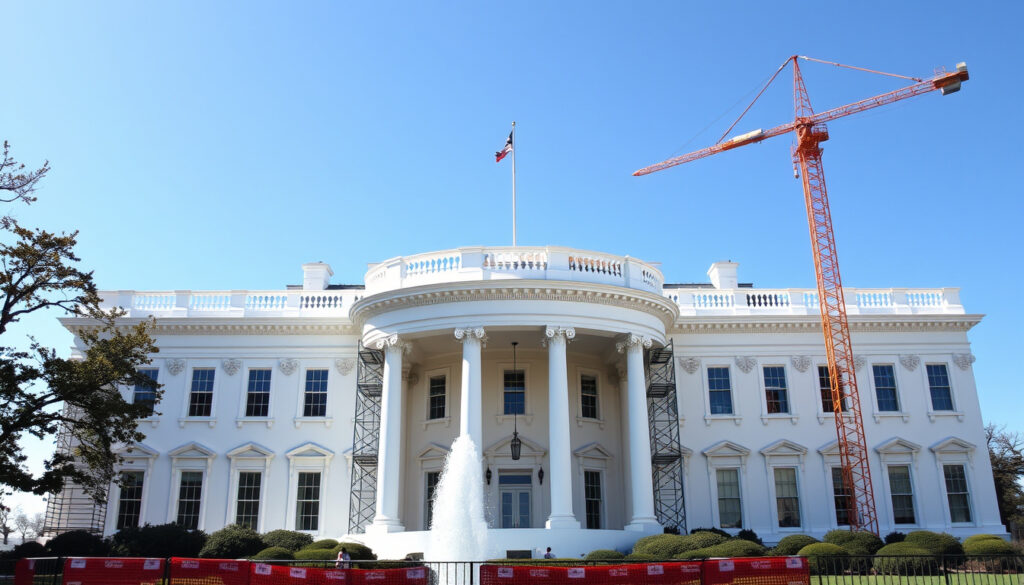
White House East Wing: History, Demolition and Future
For more than eight decades, the East Wing quietly handled the unglamorous but essential work of American governance — housing the First Lady’s staff, hosting intimate receptions, and sheltering Secret Service operations beneath its floors. By October 2025, that same structure was rubble, cleared to make way for a 90,000-square-foot ballroom. The speed of its disappearance raises questions about how the White House handles historic spaces — and who gets to decide their fate.
Built: 1902 · Expanded: 1942 · Demolished: 2025 · Ballroom Capacity: 650 guests · Public Disapproval: 53%
Quick snapshot
- East Wing built in 1902, second story added in 1942 (White House)
- Ballroom plans announced July 2025, construction to begin September 2025 (White House Briefings)
- 53% of U.S. adults disapprove of the demolition per YouGov poll (Tangle News)
- Exact day-by-day demolition schedule
- Current construction progress as of 2026
- Final cost and capacity figures for the ballroom
- 1902: Original construction · 1942: Expansion · September 2025: Announcement · September 2025: Construction start · September 2025: Demolition
- New ballroom and reconstructed East Wing target completion before Trump’s term ends in 2029 (White House Briefings)
| Attribute | Value | Source |
|---|---|---|
| Construction Year | 1902 | White House |
| Major Expansion | 1942 (second story added) | White House |
| Demolition Date | October 2025 | YouTube Explainer |
| Ballroom Announcement | July 2025 | White House Briefings |
| Ballroom Size | 90,000 square feet | White House Briefings |
| Ballroom Capacity (initial) | 650 guests | Tangle News |
| Target Completion | Before 2029 | White House Briefings |
What Was the East Wing of the White House For?
The East Wing was the functional backbone of the First Family’s daily operations. Built in 1902 under President Theodore Roosevelt and expanded with a second story in 1942 under Franklin D. Roosevelt, the structure housed the First Lady’s offices, her communications staff, and social event coordinators. It also hosted smaller White House receptions and provided additional residential space for family members.
The wing served a critical security purpose as well. Beneath the East Wing sits the Presidential Emergency Operations Center (PEOC), a fortified bunker used during crises. CBS News footage showed the rapid demolition of the structure in October 2025, with the building razed within days of President Trump’s announcement.
The East Wing’s most lasting functional legacy may be the PEOC buried below — not the offices above it.
First Lady offices
The First Lady’s staff occupied the East Wing throughout modern administrations. These offices managed correspondence, planned state events, and coordinated the social calendar that defines much of the White House’s public-facing role. Without the East Wing, those operations have temporarily relocated elsewhere in the complex.
Social functions
The East Wing’s smaller rooms handled intimate gatherings that the East Room and State Floor could not accommodate efficiently. Holiday receptions, diplomatic meetings, and press events used East Wing spaces as overflow or alternative venues.
Wartime shelter
The PEOC beneath the East Wing served as a secure location during national emergencies. This underground facility reportedly operated continuously during the Cold War and beyond, though its exact capabilities remain classified.
What’s the Difference Between the East and West Wing of the White House?
The two wings serve fundamentally different purposes and occupy opposite sides of the White House grounds. The East Wing, as noted, handled First Lady operations and social functions. The West Wing houses the Oval Office, the National Security Council, and the president’s core executive staff.
Access patterns differ sharply: West Wing visitors require extensive security clearance for even routine business, while East Wing spaces are more permeable for social guests and media events. The structural difference reflects a philosophical division between governance and ceremony.
Demolishing the East Wing removes the ceremonial infrastructure while building a ballroom that blurs the line between executive and social function in ways previous administrations avoided.
Location and access
The West Wing sits adjacent to the main residence on the north side, connected by a colonnade. The East Wing extends south and east from the residence, with its own entrance for deliveries and staff. This physical separation kept social and executive operations distinct.
Primary functions
West Wing functions include the Oval Office, Vice President’s office, Communications staff, and National Security Council workspace. East Wing functions centered on the First Lady’s offices, social event coordination, and residential quarters for family members.
Staff occupancy
West Wing staff work directly for the president on policy, communications, and political operations. East Wing staff historically work for the First Lady on scheduling, correspondence, and ceremonial planning — a distinct organizational line the demolition has disrupted.
The distinction between the wings goes beyond architecture: it reflects a philosophical split between governance and ceremony that the demolition may permanently erase.
| Feature | East Wing | West Wing |
|---|---|---|
| Primary occupant | First Lady staff | President and senior staff |
| Key rooms | Social offices, East-West Corridor | Oval Office, Situation Room |
| Public access | Limited social events | Restricted clearance required |
| PEOC location | Beneath East Wing | Not present |
| 2025 status | Demolished | Operational |
What’s Under the East Wing in the White House?
The most consequential space beneath the East Wing is the Presidential Emergency Operations Center (PEOC). This underground bunker served as a secure command post during national emergencies, most visibly during the September 11 attacks when Vice President Dick Cheney was evacuated there. The facility’s exact location and capabilities remain classified, but its existence has been confirmed through multiple official accounts.
Presidential Emergency Operations Center
The PEOC predates the current East Wing structure, having origins in the World War II era. It was expanded and hardened over subsequent decades. The facility reportedly includes communications equipment, secure meeting rooms, and direct links to military command structures. Its survival through the demolition and integration into the new construction plans remains unclear.
Other facilities
Beyond the PEOC, the East Wing basement housed mechanical systems, storage, and support facilities for the building’s operations. The White House complex includes multiple underground levels, though documentation of their exact configuration is limited due to security restrictions.
Whether the PEOC is relocated, rebuilt, or altered as part of the ballroom construction will reveal how seriously the administration takes continuity-of-government infrastructure.
The underground command post survived the Cold War and September 11 — now its fate depends on how the administration resolves a jurisdictional dispute with the National Capital Planning Commission.
When Was the White House East Wing Built?
President Theodore Roosevelt commissioned the original East Wing in 1902 to relieve crowding in the main White House residence. The architect was McKim, Mead & White, who designed a modest structure that added offices and a private entrance for the Roosevelt family. The building measured approximately 10,000 square feet — less than one-seventh the size of the planned ballroom.
The critical expansion came in 1942 under President Franklin D. Roosevelt, when a second story was added along with additional space for the growing White House staff. This expansion reflected the increasing complexity of executive operations and the need to accommodate First Lady Eleanor Roosevelt’s extensive public engagement schedule.
The 1942 addition transformed the East Wing from a modest annex into a fully functional administrative wing — meaning the building that was demolished in 2025 represented 83 years of accumulated infrastructure decisions.
1902 construction
The original East Wing cost approximately $60,000 and added four rooms plus a new entrance. Roosevelt’s need for privacy drove the project; the main White House residence had become crowded with staff and visitors. The new wing connected to the residence via a colonnade that remains visible today.
1942 expansion
World War II accelerated the need for expanded executive facilities. The second story added approximately 15,000 square feet and included offices for First Lady Eleanor Roosevelt’s extensive correspondence operation. The expansion also added the East-West Corridor that connects the wing to the residence’s second floor.
White House East Wing Demolition and Future Plans
President Trump unveiled plans for a 90,000-square-foot ballroom in October 2025, with construction scheduled to begin in September and target completion before the end of his term in 2029. The initial cost estimate was approximately $200 million, funded by Trump and private donors, with the White House releasing a list of 37 private donors. The cost reportedly rose to around $300 million due to architect and construction counsel fees, though some reports cite figures as high as $400 million.
The demolition moved with unusual speed. CBS News footage showed the structure razed within days of Trump’s public acknowledgment, drawing criticism from preservation groups and former First Lady Hillary Clinton, who posted on X: “It’s not his house. It’s your house. And he’s destroying it.”
“Presidents in the modern era have faced challenges hosting major events at the White House because it has been untouched since President Harry Truman. I am honored that President Trump has entrusted me to help bring this beautiful and necessary renovation to The People’s House.”
— Jim McCrery, CEO, McCrery Architects
“Such a significant change to a historic building of this import should follow a rigorous and deliberate design and review process.”
— Society of Architectural Historians
The National Capital Planning Commission is reviewing the project (File 8733), but the Trump administration contends the NCPC lacks authority over the demolition — a jurisdictional dispute that could determine whether future projects face similar expedited approval.
Demolition timeline
The sequence moved from announcement to demolition in approximately three months. The Society of Architectural Historians criticized the lack of a rigorous review process, stating that “such a significant change to a historic building of this import should follow a rigorous and deliberate design and review process.” A lawsuit filed against Trump and the National Park Service director sought to stop the demolition, alleging inadequate environmental and historic reviews.
Ballroom replacement
McCrery Architects was selected as the lead firm for the classical design, with Clark Construction handling construction and AECOM overseeing engineering. The ballroom capacity figures have shifted repeatedly — from 650 to 999 to 1,350 guests according to Architectural Record. The current target seating capacity appears to be 1,000 guests, compared to the East Room’s 200-person limit.
Before and after
The contrast between the modest 1902 structure and the proposed 90,000-square-foot ballroom represents a fundamental shift in how the White House prioritizes its physical space. The old East Wing was designed for function; the new ballroom is designed for spectacle. Architectural Record noted the project has been “in perpetual flux since July 2025,” with specifications changing repeatedly.
The implication: Architectural plans have shifted repeatedly since July 2025, making it difficult for oversight bodies to evaluate a moving target.
Confirmed
- East Wing built in 1902
- Second story added in 1942
- Ballroom announced July 2025
- Demolition completed October 2025
- PEOC located beneath East Wing
- 53% public disapproval (YouGov)
Unconfirmed
- Exact final cost
- Current construction progress
- PEOC relocation status
- Ballroom completion date
For preservation advocates, the message from the demolition is unambiguous: historic review processes offer limited protection when an administration chooses to act unilaterally. For supporters of the ballroom project, the long-delayed modernization of the nation’s ceremonial infrastructure justifies the speed. The outcome will set precedent for how future White House modifications proceed.
Related reading: BBC News World · Sky News front pages
The East Wing’s demolition marks a new chapter in the White House’s history and key facts, a structure that has anchored U.S. presidencies since 1800.
Frequently asked questions
Why was the White House East Wing demolished?
President Trump ordered the demolition to make way for a 90,000-square-foot ballroom. The project is funded by Trump and private donors, with the White House contending that traditional review processes do not apply to executive residence modifications.
What will replace the White House East Wing?
The new construction will include both the ballroom and a reconstructed East Wing. McCrery Architects is designing the project, with Clark Construction as the general contractor and AECOM handling engineering. Target completion is before Trump’s term ends in 2029.
What is the White House East Wing floor plan?
The demolished East Wing included offices for the First Lady’s staff, a private entrance for family members, residential quarters, and the East-West Corridor connecting to the main residence. The PEOC bunker was located beneath the structure.
Where is the Presidential Emergency Operations Center?
The PEOC was located beneath the East Wing. Its status after the demolition is unclear. The facility served as a secure command post during national emergencies, most notably during the September 11 attacks.
How has public opinion responded to the demolition?
According to an October 2025 YouGov poll, 53% of U.S. adults disapproved of the East Wing demolition while 23% approved. For general White House renovations, 33% approved and 50% disapproved.
What legal challenges have emerged?
A lawsuit was filed against Trump and the National Park Service director seeking to stop the demolition, alleging inadequate required reviews. The Society of Architectural Historians also criticized the lack of rigorous design review.
More related posts
 Paul Smith Comedy: Tour, Wife, Net Worth & Biography
 Ken Jeong: From Doctor to Hollywood Star – Biography & Facts
 Sam ung Galaxy Z Fold 7: Price, Spec & Ireland Deal
 GCSE exam dates 2026: Full timetable & key changes
 Barbie Doll Value Guide: Rare, Expensive & Controversial
 Duke of Westminster: Net Worth and Family Fortune
 Keira Walsh: Biography, Salary, Relationship Rumors
 Harry Potter Train Scotland 2026: Jacobite Steam Guide
