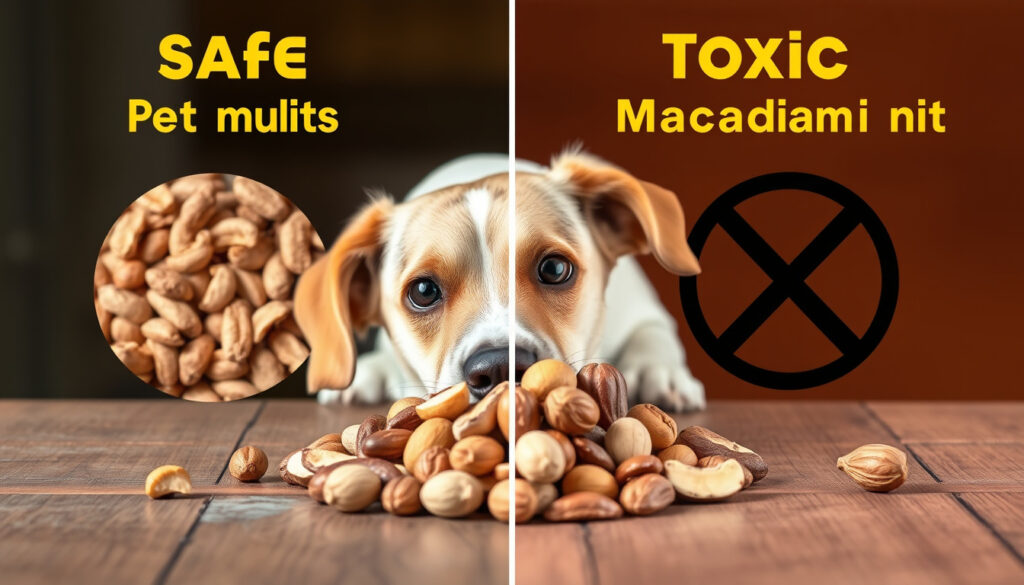
Can Dogs Eat Nuts? A Guide to Safe vs Toxic Nuts for Dogs
You’re standing in the kitchen staring at a bowl of mixed nuts, and your dog is giving you that hopeful look—but the answer isn’t a simple yes or no: macadamia nuts are toxic, while unsalted peanuts are generally safe in tiny amounts. This guide breaks down which nuts are dangerous, which are okay in tiny amounts, and how to stay safe.
Most toxic nut for dogs: Macadamia nuts ·
Safe nut option (legume): Unsalted, shelled peanuts ·
Primary health risk: Choking and intestinal blockage
Quick snapshot
- Macadamia nuts are toxic to dogs (ASPCA (animal poison control authority))
- Peanuts (unsalted, shelled) are safe in small amounts (Purina (pet nutrition experts))
- Nuts pose a choking and intestinal blockage risk (Vets Now (veterinary emergency service))
- Whether almonds are completely safe or should always be avoided due to choking risk (Purina (pet nutrition experts))
- Exact safe threshold of nuts for different dog sizes (Vets Now (veterinary emergency service))
- Whether pistachios are safe enough to recommend as a regular treat (Vets Now (veterinary emergency service))
- Macadamia nut toxicity symptoms appear within 12 hours of ingestion (ASPCA (animal poison control authority))
- Call your veterinarian or the ASPCA Animal Poison Control Center immediately if a toxic nut is ingested (Purina (pet nutrition experts))
These four categories capture the essentials: what we know, what remains uncertain, how quickly problems can appear, and the single most important action to take.
| Label | Value |
|---|---|
| Safe nuts (moderation) | Peanuts, cashews, hazelnuts, almonds (choking) |
| Toxic nuts | Macadamia, black walnuts, moldy walnuts |
| Choking hazard | All nuts, especially whole and large ones |
| Emergency contact | Veterinarian or pet poison helpline |
Can dogs eat nuts?
General safety overview
Whether dogs can eat nuts depends entirely on the type of nut. Purina (pet nutrition experts) states that some nuts pose little risk if given in small amounts as a special treat, while others can be toxic or cause serious health problems. Even dog-friendly nuts can cause adverse effects if fed too often.
A single macadamia nut can trigger weakness and vomiting in a 10-pound dog, while the same dog could eat a whole unsalted peanut with no issue. The range is that wide.
Key takeaway: moderation is critical
- Only certain nuts are safe in small quantities (Purina (pet nutrition experts))
- Nuts pose choking and obstruction risks regardless of type (Vets Now (veterinary emergency service))
- Always remove shells and avoid salt/seasonings (Vets Now (veterinary emergency service))
The pattern is clear: nuts are not a natural part of a dog’s diet, and even the safe ones demand strict portion control.
What nuts are not poisonous to dogs?
List of safe nuts
- Peanuts (a legume) – safe when unsalted and shelled (Purina (pet nutrition experts))
- Cashews – non-toxic but high in fat, so limit quantity (Purina (pet nutrition experts))
- Hazelnuts – generally safe in small amounts (Vets Now (veterinary emergency service))
- Almonds – not toxic but a choking hazard, especially for small breeds (Purina (pet nutrition experts))
Preventive Vet (pet health advisory) emphasizes that even safe nuts should be given as occasional treats, not meal replacements.
How to serve nuts safely
- Always remove shells – pistachio shells are indigestible and can cause blockages (Vets Now (veterinary emergency service))
- Serve unsalted, unseasoned, and dry-roasted or raw (Purina (pet nutrition experts))
- Chop larger nuts to reduce choking risk (Vets Now (veterinary emergency service))
What this means: the safest approach is to treat nuts like a rare jackpot – tiny, infrequent, and stripped of all extras.
What nut is toxic to dogs?
List of toxic nuts
- Macadamia nuts – highly toxic; even a small number can cause severe symptoms (ASPCA (animal poison control authority))
- Black walnuts – dangerous and can cause toxicity (Vets Now (veterinary emergency service))
- Moldy walnuts – contain tremorgenic mycotoxins that can cause seizures (Vets Now (veterinary emergency service))
- Pecans – high fat content can trigger pancreatitis (Purina (pet nutrition experts))
Symptoms of nut toxicity
The ASPCA (animal poison control authority) lists weakness, incoordination, depression, vomiting, tremors, and hyperthermia as signs of macadamia nut poisoning. Vets Now (veterinary emergency service) adds that high-fat nuts like pecans and walnuts can cause pancreatitis, leading to vomiting, diarrhea, and abdominal pain.
Macadamia nuts are the single most dangerous nut your dog can eat – and they’re common in trail mixes and gift baskets. One accidental handful can mean a midnight trip to the emergency vet.
The trade-off: even non-toxic nuts carry a fat load that can upset a dog’s system, so the line between “safe” and “risky” is thinner than most owners realize.
What happens if my dog ate one nut?
Immediate steps to take
- Stay calm and assess the situation – identify the nut type and quantity.
- Check for choking: if your dog is pawing at the mouth, coughing, or unable to breathe, perform a dog Heimlich maneuver and call your vet.
- If the nut was toxic (macadamia, black walnut, moldy walnut), contact your veterinarian or the ASPCA Animal Poison Control Center (888-426-4435) immediately.
- Note the time of ingestion and the amount eaten – this information is critical for the vet.
When to contact a veterinarian
Purina (pet nutrition experts) advises contacting a vet if the nut was a known toxic variety, or if your dog shows any signs of distress such as vomiting, lethargy, loss of coordination, or unusual behaviour. Even if the nut was safe, monitor for 12–24 hours for delayed symptoms.
The implication: a single nut rarely causes disaster, but because dogs vary in size and sensitivity, erring on the side of caution is the only responsible play.
What is the 90/10 rule dog?
Applying the 90/10 rule to nut treats
The 90/10 rule is a widely recommended guideline for treat intake: 90% of your dog’s daily calories should come from a complete and balanced dog food, leaving no more than 10% for treats. Purina (pet nutrition experts) explains that this helps prevent obesity and nutritional imbalances. Safe nuts, being calorie-dense and high in fat, fall squarely into the 10% treat category.
- 90% of diet should be complete and balanced dog food (Purina (pet nutrition experts))
- 10% or less can be treats, including safe nuts (Preventive Vet (pet health advisory))
- Even safe nuts should be given sparingly to avoid obesity and pancreatitis (PetMD (veterinary health resource))
Balancing treats with nutrition
PetMD (veterinary health resource) notes that a single cashew contains about 10 calories; for a 20-pound dog, that’s already 2% of their daily calorie budget. Add a few more, and the 10% bucket fills fast.
The catch: the 90/10 rule isn’t a license to give nuts daily – it’s a reminder that every treat has a calorie cost, and nuts are among the priciest.
Five nut types, one pattern: the line between safe and toxic is defined less by the nut itself and more by how it’s prepared and how much the dog eats.
| Nut | Safety status | Primary risk | Symptoms if eaten in excess |
|---|---|---|---|
| Peanuts (unsalted, shelled) | Safe in moderation | Choking, high fat | Stomach upset, obesity |
| Cashews | Safe in moderation | High fat | Pancreatitis (if large amounts) |
| Macadamia nuts | Toxic | Neurotoxicity | Weakness, vomiting, tremors, hyperthermia |
| Black walnuts | Toxic | Toxicity, mycotoxins (if moldy) | Vomiting, seizures |
| Almonds | Non-toxic but risky | Choking, sharp edges | Choking, intestinal blockages |
Emergency protocol: what to do if your dog eats a nut
- Identify the nut – check labels, recall the container, look for shells or mold.
- Assess the dog – is there coughing, pawing at mouth, difficulty breathing? If yes, perform the Heimlich maneuver for dogs and call the vet while en route.
- Determine toxicity – if the nut is macadamia, black walnut, or moldy walnut, treat as emergency.
- Call your vet or the ASPCA Poison Control (888-426-4435) – have the nut type, approximate count, and time of ingestion ready.
- Do not induce vomiting unless explicitly instructed by a veterinarian – some nuts can cause more damage coming up.
- Monitor closely for 24 hours – watch for vomiting, diarrhoea, lethargy, wobbliness, or any change in behaviour.
Why this matters: a swift, calm response can turn a potential poisoning into a manageable scare. Delay, on the other hand, can turn a single nut into a serious case.
Confirmed facts
- Macadamia nuts are toxic to dogs (ASPCA)
- Peanuts (unsalted, shelled) are safe in small amounts (Purina)
- Nuts pose a choking and intestinal blockage risk (Vets Now)
What’s unclear
- Whether almonds are completely safe or should always be avoided due to choking hazard (Purina)
- Exact safe threshold of nuts for different dog sizes (Vets Now)
- Whether pistachios are safe enough to recommend as a regular treat (Vets Now)
While almonds aren’t toxic to dogs, they can pose potential health problems and should be avoided.
– Dr. Goldstein, PetMD (veterinary health resource)
Many nuts and seeds are toxic, as well as choking and obstruction hazards.
Both experts agree: the safest nut for your dog is none at all – but if you do offer one, choose wisely and sparingly.
For pet owners, the decision comes down to risk versus reward. A single unsalted peanut won’t hurt most dogs, but the same dog could be in trouble after one macadamia nut. The 90/10 rule gives a clear framework: treats belong in the tiny 10% slice, and nuts are treats, not food. For the dog owner who wants to spoil their pet without the vet bill, the choice is simple: skip the nut bowl entirely, or stick to a single shelled peanut and call it a day.
Related reading
- Can Dogs Eat Raspberries – Safety Benefits and Feeding Guide – another feeding guide for safe human foods.
- Foods to Avoid When Taking Folic Acid: NHS & WebMD – broader look at foods to avoid for health reasons.
nutrish.com, mywoof.com, harmonyanimalhospital.net, goodrx.com
For a detailed breakdown of which varieties are safe and which are dangerous, see this guide on safe vs toxic nuts for dogs.
Frequently asked questions
Can dogs eat almonds?
Almonds are not toxic, but they are a choking hazard, especially for smaller breeds. They can also cause digestive upset due to their high fat content.
Can dogs eat cashews?
Yes, cashews are non-toxic to dogs. However, their high fat and protein content means they should be fed only in very small amounts as an occasional treat.
Are peanuts good for dogs?
Unsalted, shelled peanuts are safe in moderation. They are not nutritionally necessary but can be a low-fat treat option. Avoid salted, flavored, or shelled peanuts.
How many nuts can a dog safely eat?
There is no exact number, but a good rule is to limit nuts to no more than 10% of daily calories. For a small dog, one or two small nuts per week; for a large dog, up to a handful – but always check for choking risk.
Is peanut butter safe for dogs?
Yes, as long as it does not contain xylitol. Many commercial peanut butters contain this artificial sweetener, which is highly toxic to dogs. Check the label before sharing.
More related posts
 Lisa Stansfield 2026 Tour: What We Know
 Snakes and Ladders Brentford: Session Times, Prices and Parking
 Andy Cole’s Kidney Transplant: Recovery and Advocacy
 Arthur Miller: Life, Works, and Marriage to Marilyn Monroe
 David Wenham – Biography, Age, Wife, and Famous Roles
 Best 40 Inch Smart TV 2026: Reviews, Prices & Buying Guide
 Eddie Kadi: Biography, Age, Family, Strictly Come Dancing 2023
 Elizabeth Gillies: Biography, Career Facts & Updates
