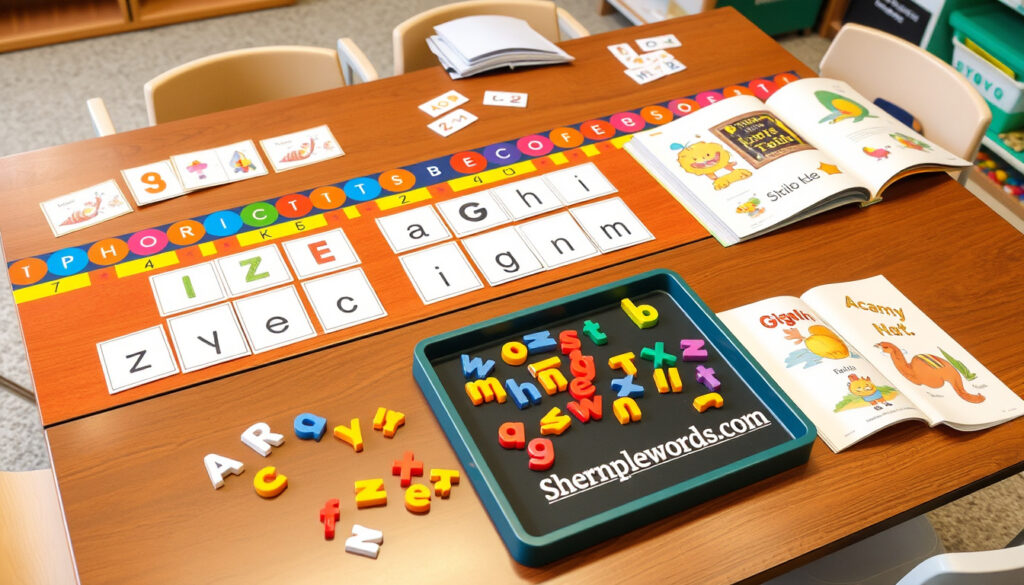
Little Wandle Phonics: Guide for Parents and Teachers
If you’ve spent any time around a UK primary school classroom lately, you’ve probably heard the name Little Wandle. It’s the phonics programme that seems to be everywhere — and for good reason.
Schools using Little Wandle: over 5,500 · Age range: 4–7 years · Validation: Department for Education (DfE) · Programme type: Systematic synthetic phonics · Phases: 2–5 (plus Phase 1 and 6)
Quick snapshot
- Little Wandle is a DfE-validated systematic synthetic phonics programme (Little Wandle Letters and Sounds Revised (official programme website))
- It is used by over 5,500 schools in England (Little Wandle Letters and Sounds Revised (official programme website))
- The core Reception programme runs for 26 weeks (Reading Chest (parent resource site))
- Long-term reading attainment beyond Year 2 hasn’t been measured in large-scale independent studies (WordPatch (independent phonics blog))
- Reception: Phase 2 (Autumn), Phase 3 (Spring/Summer), 26-week core programme (Elmridge Bright Futures (school phonics overview))
- Year 1: Review Phases 3&4, then Phase 5 with alternative spellings (Batheaston Primary (school pacing document))
- Year 2: Fluency and spelling programme (Reading Chest (parent resource site))
- Phonics screening check in Year 1 – programme designed to exceed expectations (Sandy Hill School (primary school phonics page))
- Transition to spelling programme in Year 2 (Thornhill Lees (school progression map))
Seven programme facts at a glance — one pattern: every element is built around systematic, sequential learning with clear end-of-phase goals.
| Attribute | Detail |
|---|---|
| Programme name | Little Wandle Letters and Sounds Revised |
| Type | Systematic synthetic phonics |
| Validation | Department for Education (DfE) |
| Schools using it | Over 5,500 |
| Publisher | Collins |
| Age range | 4–7 years |
| Phases | 2–5 (plus Phase 1 and 6) |
What is Little Wandle phonics?
Little Wandle Letters and Sounds Revised is a systematic synthetic phonics programme designed to teach children to read from scratch. It’s a revised version of the government’s original Letters and Sounds framework, updated with modern classroom research and structured progression.
How does Little Wandle work?
- Daily phonics lessons follow a set progression of grapheme-phoneme correspondences (GPCs) and tricky words (Little Wandle (support for teachers))
- Reading practice sessions use fully decodable books matched to each child’s current phonics phase
- Three reads per book build decoding, prosody, and comprehension (WordPatch (independent phonics blog))
What this means: Teachers get a scripted, week-by-week plan so they spend less time creating resources and more time teaching. The trade-off: less flexibility for schools that prefer to tailor their own phonics sequence.
What are the key components of Little Wandle?
- Assessment tools – regular ‘keep-up’ checks to identify children falling behind (Little Wandle (support for teachers))
- Parent resources – guides on pronunciation and how to read decodable books at home (Little Wandle (for parents))
- Fully resourced phonics packs – grapheme cards, word cards, and wall friezes
The pattern: Little Wandle is a complete package, not just a lesson plan. Schools that adopt it get everything from training to printable resources. That’s likely why adoption has been so rapid – it reduces implementation friction for staff.
What age is Little Wandle for?
Little Wandle is primarily designed for children in Reception and Year 1 (ages 4–6), with a catch-up programme for Year 2 (age 7) (WordPatch (independent phonics blog)). The core Reception programme covers 26 weeks, Phase 2 through Phase 4, while Year 1 tackles Phase 5 including alternative spellings.
Is Little Wandle used in Reception?
Yes – Reception is the main entry point. Children begin Phase 2 in the autumn term, learning set 1 sounds (s, a, t, p, i, n) and progress through Phase 3 digraphs and trigraphs by spring (Elmridge Bright Futures (school phonics overview)). The programme expects children to be blending CVC words by the end of Reception.
What about Year 1 and Year 2?
- Year 1: reviews Phases 3 and 4, then moves into Phase 5 where alternative spellings (e.g., /ai/ as ay, a-e, ey) are taught systematically (Batheaston Primary (school pacing document))
- Year 2: transitions from phonics to a spelling programme, though children who need extra support continue using Little Wandle resources (Thornhill Lees (school progression map))
Why this matters: The age-range design means a single programme can serve a whole infant school, but Year 2 teachers may need to manage a split between fluent readers and catch-up pupils.
Is Little Wandle any good?
With DfE validation and adoption by thousands of schools, Little Wandle clearly meets baseline quality standards. Teacher feedback on platforms like WordPatch and school websites is generally positive, praising the structure and resources (WordPatch (independent phonics blog)). But it’s not without trade-offs.
Little Wandle offers a tightly scripted, all-in-one system that reduces teacher planning – but schools that prefer a more flexible, child-led approach may find the pace too rigid for mixed-ability classes.
What are the pros and cons of Little Wandle?
Upsides
- DfE-validated – meets government quality standards
- Comprehensive resources reduce teacher workload
- Clear progression and assessment tools (Little Wandle (support for teachers))
- Parent-friendly home reading materials (Little Wandle (for parents))
Downsides
- Whole-class approach may not suit every learner without additional interventions
- Limited flexibility for schools that want to rearrange phase order
- Cost of resources (books, training) can be a barrier for small schools
- Long-term impact beyond Year 2 not independently confirmed (WordPatch (independent phonics blog))
How does Little Wandle compare to other programs?
Three validated programmes, one key difference: Little Wandle is the only one that grew out of a DfE revision of Letters and Sounds, while others like Read Write Inc. and Jolly Phonics have older proprietary roots.
| Programme | Validation | Core approach | School adoption |
|---|---|---|---|
| Little Wandle | DfE validated | Systematic synthetic phonics, three reads model | Over 5,500 |
| Read Write Inc. | DfE validated | Phonics with storybooks, partner work | Over 4,000 |
| Jolly Phonics | DfE validated | Multi-sensory, actions for each sound | Widespread internationally |
The implication: While all three are DfE-validated, Little Wandle’s deeper integration with the revised Letters and Sounds framework means it’s the most seamless for schools that previously used DfE documents. Schools already using Read Write Inc. would face a bigger transition cost.
What is the Little Wandle reading approach?
The programme is built around systematic synthetic phonics – teaching children the 44 phonemes and their grapheme representations in a defined sequence. But what sets Little Wandle apart is its reading practice sessions, where each decodable book is read three times (WordPatch (independent phonics blog)).
What is the ‘three reads’ model?
Every week, children read the same decodable book three times with a teacher or teaching assistant. Each read targets a different skill:
- First read: Decoding and blending – focusing on sounding out each word accurately
- Second read: Prosody and fluency – reading with expression and pace
- Third read: Comprehension – discussing what happened, characters, and vocabulary
By the third read, children have encountered the same text three different ways – so even struggling readers build confidence because they already know the story. This repetition is deliberate: it closes the gap between decoding speed and comprehension ability.
How is reading taught in Little Wandle?
- Daily 20-minute phonics lesson introducing new GPCs and tricky words
- Three 15-minute reading practice sessions per week with a trained adult
- Fully decodable books – only graphemes and tricky words the child has already been taught appear in the text
- Home reading: the same decodable book is sent home for additional practice (Little Wandle (for parents))
The catch: This model works brilliantly for schools with enough staff to deliver three sessions per group per week. But in schools with high teacher turnover or fewer TAs, the three-read cycle can be hard to maintain consistently.
What is the three reads model?
Since the three reads model is the heart of Little Wandle’s reading approach, here’s a step-by-step breakdown of how each session looks in practice.
- Step 1: Decode and blend (first read) – The child points to each word and sounds it out, then blends the sounds together to read the word aloud. Teacher corrects errors immediately, prompting the child to re-read accurately. Focus: word accuracy, not speed.
- Step 2: Prosody and fluency (second read) – Child re-reads the same book, this time paying attention to punctuation, expression, and phrasing. Teacher models how to read with emotion – e.g., asking, “How would the character say that?” Focus: pace and intonation.
- Step 3: Comprehension (third read) – Child reads again, but now stops to answer questions about the story, characters, and vocabulary. Teacher asks inferential questions (why?, what if?) to build understanding. Focus: understanding the text, not just decoding it.
Too many phonics programmes stop at decoding. Little Wandle ensures children don’t become ‘barking at print’ – they actually understand and enjoy what they read. This separation of skills is what makes the three reads model effective, but it also demands time and staffing.
Confirmed facts and what remains unclear
Confirmed facts
- Little Wandle is a DfE-validated phonics programme based on Letters and Sounds Revised
- Over 5,500 schools use it
- The three reads model is a core component of reading practice sessions
- Reception core programme is 26 weeks long (Reading Chest (parent resource site))
- Phase 5 alternative spellings are taught in Year 1 (Batheaston Primary (school pacing document))
What’s unclear
- Long-term reading attainment beyond Year 2 – no large-scale independent studies exist (WordPatch (independent phonics blog))
- Cost-effectiveness compared to other DfE-validated programmes – no published cost-benefit analyses
- How well the programme works for children with SEND in mainstream settings – limited published evidence
- Direct head-to-head effectiveness against other DfE-validated programmes is not available from published research
- Impact on reading enjoyment or motivation beyond decoding not measured
“Little Wandle Letters and Sounds Revised is a complete systematic synthetic phonics programme that has been validated by the Department for Education.”
— Little Wandle Letters and Sounds Revised (official programme website)
“The resources from Collins provide everything a school needs to deliver the programme, including fully decodable books and supporting materials for parents.”
For schools and parents evaluating Little Wandle, the choice is clear: adopt it if you value a well-structured, fully resourced programme with strong government validation. But be prepared for the trade-off – it requires consistent staffing to deliver the three reads model, and the long-term evidence beyond age 7 is still building. For teachers, the immediate benefit is reduced planning time. For parents, the home-reading component offers a clear way to support learning. The real test will come as more Year 2 cohorts move through key stage 2 and we see how well the fluency foundation holds.
hever.kent.sch.uk, lawn.derby.sch.uk, littlewandle.org.uk, stmaryssw.org.uk
Frequently asked questions
How do I log in to Little Wandle?
Teachers can log in via the official Little Wandle website. School subscriptions provide access to the full resource suite, including lesson plans, assessment tools, and printable materials. Contact your school’s phonics lead for login details.
What is the Little Wandle assessment?
The programme includes regular ‘keep-up’ assessments that happen every six weeks. Teachers track which GPCs and tricky words each child has secured, then provide targeted intervention for those falling behind (Little Wandle (support for teachers)).
How do I teach tricky words in Little Wandle?
Tricky words (e.g., ‘the’, ‘said’, ‘was’) are taught through a ‘say the word, identify the tricky part, practice reading and writing’ routine. Each phase has a defined list of tricky words that children must learn by sight (Little Wandle (for parents)).
What are Little Wandle Phase 2 and Phase 3?
Phase 2 covers the first 19 graphemes (s, a, t, p, i, n, m, d, g, o, c, k, ck, e, u, r, h, b, f, l). Phase 3 introduces digraphs (sh, th, ng, ai, ee, igh, oa, oo) and trigraphs (air, ure, ear). Both are taught in Reception.
Where can I buy Little Wandle books?
Decodable books for Little Wandle are published by Collins and are available through Collins online shop and educational retailers (Collins Education).
Is Little Wandle free?
The full programme requires a paid subscription per school. Some resources, including parent guides and sample materials, are available free on the official website. Individual books can be purchased separately.
How does Little Wandle support children with SEND?
The programme includes guidance for adapting lessons for children with special educational needs, such as using additional repetition, smaller group sizes, and visual supports. Schools are encouraged to use the ‘keep-up’ intervention model.
What is the Little Wandle app?
There is no official Little Wandle app for parents. However, Collins offers a range of digital resources including e-books and interactive activities through its Collins Hub platform.
Related reading
More related posts
 Meghan and Harry Latest: Current News and Updates
 Corey Gamble: Bio, Net Worth, and Career Facts
 Wilfred Owen: Biography, Poems, and Lasting Legacy
 Why Does My Cat Lick Me – Reasons and Meanings Explained
 Confidence Man: Band Profile, Members, and Satirical Electropop
 Wycombe Wanderers F.C.: League, History, Players & FAQs
 Tom Welling Movies and TV Shows – Complete Filmography Guide
 Cast of Carry-On 2024 – Full Cast List and Key Roles
