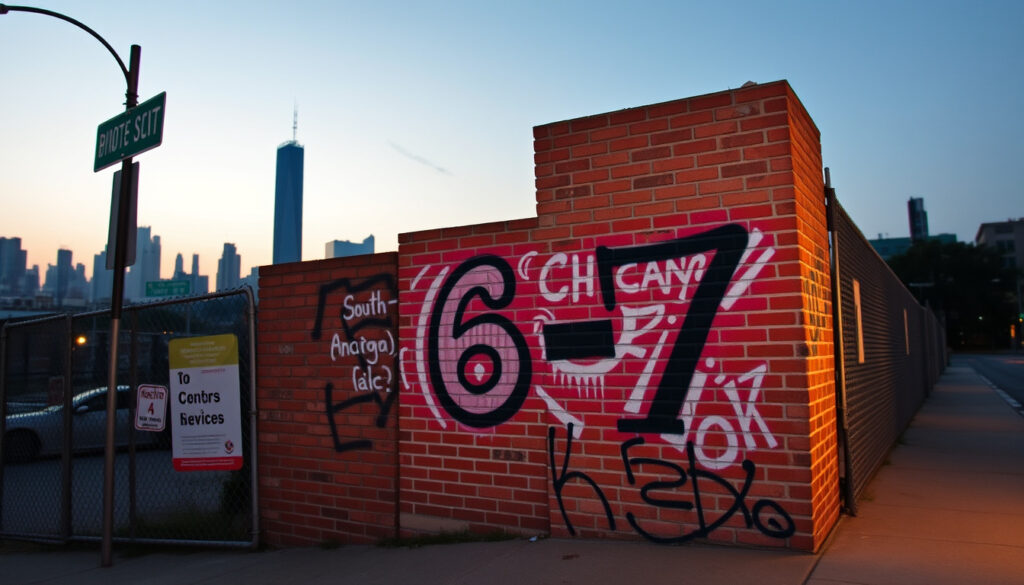
What Does 6 7 Mean Slang – Chicago Origins and Meme Evolution
The slang term “67” (also written as “6-7”) has undergone a remarkable transformation from Chicago street code to internet meme phenomenon. Originating within the city’s drill rap scene as a reference to 67th Street and associated territorial boundaries, the term gained mainstream attention in late 2024 through rapper Skrilla’s song “Doot Doot.” Its subsequent spread across TikTok and Instagram introduced the phrase to audiences far removed from its original context, creating a disconnect between the slang’s roots and its current viral usage.
The evolution of “67” illustrates how local gang-related terminology can rapidly permeate internet culture, often losing its original connotations in the process. Understanding what the term means requires examining both its Chicago drill origins and the various ways it has been reinterpreted by online communities in 2024 and 2025.
What Does “67” Mean? Core Interpretations Explained
The slang term carries different meanings depending on context. At its foundation, “67” refers to a specific Chicago location with deep ties to local gang culture, but the phrase has since branched into multiple interpretations across different communities.
The term “67” primarily refers to 67th Street in Chicago, but its meaning shifts dramatically depending on whether you’re discussing gang culture, drill music, or internet memes.
Four distinct interpretations have emerged across different contexts:
- Chicago Gang/Block Reference: “67” denotes 67th Street as a territorial location tied to specific crews and affiliations within Chicago’s street hierarchy
- Drill Rap Usage: Artists incorporate the term into lyrics and social media as a marker of identity, connection to neighborhoods, and sometimes as a flex or tribute
- Texting/Social Media Variant: “6-7” appears in casual online communication, often used ironically or as shorthand for something vaguely impressive
- UK Drill Distinction: The 67 crew from Brixton, London operates independently, representing a British interpretation of the numeric gang tag concept
Key Insights on “67” Slang
- The term traces its roots to Chicago’s South Side, where street numbers serve as powerful identifiers for gang territories and local crews
- Chicago drill rappers like King Von (from O Block) and Lil Durk (OTF collective) have embedded such references throughout their music, helping popularize the terminology
- The slang gained viral internet momentum in 2024–2025, largely through TikTok memes tied to NBA player LaMelo Ball’s 6’7″ height
- “67” exists alongside similar references like “64,” which represents competing or adjacent territories, creating a system of numeric gang codes
- The term’s adoption by internet culture has led to various sub-memes, including the “67 kid” archetype and horror-themed edits
- Using the term carries potential risks in real-world contexts due to its association with active gang affiliations and ongoing territorial disputes
| Fact | Details |
|---|---|
| Origin | 67th Street, Chicago South Side |
| Primary Association | Territorial gang reference within Chicago drill culture |
| Key Figures | King Von (O Block), Lil Durk (OTF), Skrilla |
| Geographic Tie | South Side Chicago; specific blocks and crews |
| Media Exposure | Viral TikTok/Instagram memes (2024–2025); Skrilla’s “Doot Doot” |
| Variants | 64 (rival block), UK 67 crew, “6-7” texting form |
| Meme Evolution | Drill lyric → LaMelo Ball edits → “67 kid” → horror variants |
| Cultural Shift | Street code → internet meme; local → global spread |
The Chicago Drill Connection and Gang Origins
Chicago drill music serves as the primary vehicle through which terms like “67” have spread beyond their immediate geographic origins. This gritty rap subgenre, known for its raw depiction of street life and ongoing gang rivalries, provides the cultural framework that gives the terminology its weight and controversy.
Understanding “67” in Drill Context
Within Chicago’s drill scene, “67” functions as more than a simple location marker. The term refers to 67th Street, a specific corridor associated with particular blocks and crews whose histories intertwine with the broader narrative of South Side Chicago gang dynamics. The 2010s saw the emergence of these numeric gang codes within the Black Disciples (BD) affiliation, creating a system where numbers denote hyper-local territories and their associated crews.
Drill artists encode these references throughout their music, using them to signal allegiance, pay tribute to fallen associates, or send messages to rivals. King Von, who was killed in 2020 and hailed from O Block (which falls within the STL/EBT set), frequently referenced such neighborhood codes in his tracks. Similarly, Lil Durk and the OTF (Only The Family) collective have built entire lyrical frameworks around these geographic identifiers.
The rivalry between areas like O Block and competing territories has fueled countless diss tracks and ongoing feuds that form the backdrop against which terms like “67” gain their meaning.
Distinguishing “64” from “67”
While search results and cultural discussions often focus on “67,” the Chicago drill landscape includes the contrasting reference “64,” which typically denotes 64th Street or related sets operating as opposing factions. This numeric rivalry mirrors the broader O Block versus rivals dynamic, where territorial disputes translate directly into musical conflict.
The relationship between these numeric references follows established patterns in Chicago gang culture, where specific street numbers carry distinct associations and often represent active rivalries. Tracks by King Von and Lil Durk have referenced both numbers, contributing to their establishment as recognized codes within the drill lexicon.
How “67” Became a Viral Internet Meme
The transformation of “67” from street terminology to internet meme represents a textbook case of how local cultural references can rapidly detach from their origins when they encounter viral social media platforms.
The Role of Skrilla’s “Doot Doot”
The late 2024 release of Skrilla’s song “Doot Doot” provided the specific lyric that would propel “67” into mainstream internet consciousness. The phrase “6-7” within the track shouted out the Chicago street amid the scene’s characteristic themes of territorial identity and neighborhood loyalty. This musical moment coincided with growing interest in drill rap among online audiences, creating the conditions for rapid spread.
The song’s lyrics provided the raw material that TikTok and Instagram creators would soon repurpose for their own content, demonstrating how music continues to serve as a primary engine for slang propagation in digital spaces.
TikTok and Instagram Meme Spread
Users on TikTok and Instagram quickly adopted the “67” lyric from “Doot Doot,” syncing it with various video content in ways that created humor through juxtaposition. The most prominent pattern involved pairing the phrase with NBA player LaMelo Ball highlights, exploiting the coincidence that Ball stands 6’7″ tall. This connection spawned countless “domination” edits that treated the basketball player as the embodiment of whatever “67” supposedly represents.
The meme evolved to include ironic applications where users would reference “67” for anything vaguely impressive or cringy, expanding its usage beyond any coherent meaning. This typical meme evolution pattern—where original context gives way to pure ironic signposting—characterizes the term’s current online presence.
The “67 Kid” Phenomenon and Gen Z Spread
March 2025 marked a significant escalation in the meme’s visibility when content creator Cam Wilder featured a blonde child with a distinctive “ice cream haircut” yelling “67” in one of his vlogs. This figure became instantly recognizable as the “67 kid,” spawning a wave of reaction content and parody videos that further detached the term from its Chicago origins.
The “67 kid” became a focal point for Gen Z and Alpha stereotypes, being described as emblematic of cringe culture and the “Mason 67 archetype”—a figure who overuses trendy slang without understanding its origins or implications.
The meme’s association with youth culture and perceived overuse contributed to its transformation into a subject of mockery and commentary rather than a term actively used by most internet users. This cycle of adoption, overexposure, and ironic rejection represents a common trajectory for viral slang terms.
Horror Variants and SCP067
Between April and August 2025, the “67 kid” became the subject of increasingly disturbing edits that transformed the cheerful child into nightmare fuel material. These “SCP067” variants depicted the figure with glowing eyes, gaping mouths, and anti-piracy warning screens overlaid on their faces—reminiscent of established SCP universe horror creatures like SCP-096 and SCP-1471.
These horror adaptations represent the meme reaching full internet folklore status, where original context dissolves entirely into surreal digital legend. The transformation from wholesome viral clip to nightmare fuel demonstrates how quickly internet culture can repurpose any recognizable figure for creative or comedic purposes far removed from the original content.
Regional Variations and Texting Forms
The geographic spread of “67” terminology extends beyond Chicago, though interpretations vary significantly between regions. Understanding these variations provides insight into how local slang codes adapt when they encounter new cultural environments.
UK Drill and the Brixton 67 Connection
While search results lack a direct link between Chicago’s “67” and UK drill culture, the British scene features its own 67 crew based in Brixton, London. This coincidence of naming reflects broader patterns in UK drill, where numeric gang tags serve similar territorial identification functions as their Chicago counterparts.
UK drill artists use numbers to denote crew affiliations and territorial claims, with rivalries like 67 versus 41 representing British interpretations of the numeric gang code system. The influence of Chicago drill on UK variants became particularly visible post-2010s, as British artists incorporated American stylistic elements while maintaining local relevance through their own geographic identifiers.
Texting and Modern Slang Adaptations
In texting and casual online communication, “6-7” appears as a flexible shorthand that retains little of its original gang or territorial significance. Radio segments and explainer content targeting older audiences have addressed the term, attempting to bridge generational gaps in slang comprehension.
The ironic usage pattern that characterizes much internet slang applies to “6-7” as well, where the term can signify anything from genuine admiration to sarcastic commentary on perceived pretension. This semantic flexibility allows the term to function as a conversational marker without requiring specific shared understanding of its origins.
The Cultural Impact of Numeric Gang Slang
The journey of terms like “67” from street code to internet meme raises important questions about cultural appropriation, linguistic evolution, and the relationship between local communities and global internet audiences.
From Local Code to Global Phenomenon
The transformation of “67” illustrates broader patterns in how local linguistic codes spread through digital spaces. Terms rooted in specific geographic territories and cultural histories can rapidly achieve global recognition, but this spread often comes at the cost of stripping away contextual meaning and potentially contributing to the trivialization of serious cultural issues.
For communities where terms like “67” retain genuine significance as markers of identity, belonging, and sometimes active territorial conflict, the memeification of such references can feel jarring or disrespectful. Yet this tension reflects fundamental dynamics of cultural exchange in internet-era communication.
Drill Music’s Role in Slang Propagation
Chicago drill artists have served as primary agents in translating street-level terminology into mainstream cultural currency. Through their music and social media presence, artists like King Von and Lil Durk encode neighborhood histories, territorial disputes, and community identities into accessible artistic formats. The evolution of slang terms like “67” from street-level usage to mainstream cultural currency is a fascinating phenomenon, and you can explore the history of this specific term at $ريال مدريد وبرشلونة تاريخ المواجهة.
This encoding process serves multiple functions: it preserves local narratives, provides income and status for artists from marginalized communities, and introduces audiences far removed from Chicago’s streets to cultural references they may never fully understand. The tension between appreciation and appropriation plays out continuously in how drill-adjacent slang spreads online.
Navigating Respectful Usage
For those encountering terms like “67” through internet culture, understanding their origins provides essential context for respectful engagement. The term’s roots in Chicago gang culture involve real histories of conflict, loss, and ongoing territorial disputes that extend far beyond meme aesthetics.
Recognizing that casual internet usage can trivialize serious cultural phenomena doesn’t necessarily demand abstention from using such terms, but it does suggest awareness of their weight and origins. Exploring related drill music and cultural contexts offers pathways to deeper understanding beyond surface-level meme engagement.
Timeline: The Evolution of “67” Slang
The progression of “67” from obscure Chicago reference to viral internet phenomenon follows a compressed timeline characteristic of modern meme culture:
- 2010s: Chicago drill rap emerges as a distinct subgenre, establishing numeric gang codes including “67” as standard elements of lyrical vocabulary
- 2018–2020: King Von and Lil Durk popularize neighborhood references including O Block and associated numbers through their growing mainstream presence
- Late 2024: Skrilla releases “Doot Doot” featuring the “6-7” lyric that will drive viral spread; TikTok and Instagram users begin adapting the phrase
- Early 2025: LaMelo Ball edits proliferate as the primary meme format connecting “67” to the NBA player’s 6’7″ height
- March 2025: Cam Wilder’s vlog introduces the “67 kid” archetype, spawning countless reaction and parody videos
- April–August 2025: Horror variants including “SCP067” emerge, transforming the meme into digital folklore material
What’s Verified and What Remains Unclear
When examining slang terminology with roots in gang culture and viral internet spread, distinguishing established facts from speculation proves essential for accurate understanding.
| Established Information | Unclear or Unverified |
|---|---|
| “67” refers to 67th Street in Chicago | Specific details about ongoing territorial disputes between 64 and 67 |
| Chicago drill provides the primary cultural context | Complete history of 64 origins and its relationship to “67” |
| King Von and Lil Durk have referenced such codes in music | Full extent of real-world violence tied to numeric gang references |
| Viral meme spread occurred through TikTok/Instagram in 2024–2025 | Specific evolution of texting variants beyond ironic usage |
The available sources emphasize meme history over detailed gang dynamics, leaving significant gaps in understanding the complete context surrounding “67” terminology. For fuller historical background, cross-referencing drill discographies and documented gang histories provides additional perspective.
The Broader Significance of Chicago Drill Slang
Terms like “67” represent a specific linguistic phenomenon rooted in Chicago’s unique combination of geographic territorial systems, musical innovation, and ongoing cultural production through drill rap. The numeric gang code system reflects deeper social structures where neighborhood identity carries profound significance for those embedded within local communities.
The Black Disciples (BD) affiliation that helped establish numeric territorial codes in the 2010s provides historical context for how such terminology develops and spreads. These systems emerge organically from community organization patterns but gain wider exposure through artistic expression and subsequent internet meme culture.
For audiences encountering such terms for the first time through internet content, recognizing their origins in Chicago’s South Side communities and the ongoing territorial dynamics that give them meaning provides essential context for understanding their cultural weight.
Sources and Cultural References
Understanding “67” terminology requires engaging with primary cultural sources where the term appears in context:
Chicago drill music provides the foundational material where terms like “67” gain their most authentic meaning. Artists encode neighborhood references, territorial claims, and community histories throughout their tracks, creating a lyrical ecosystem where such numbers carry specific significance.
Urban Dictionary and rap-focused forums offer crowdsourced interpretations that track how terminology evolves and gains new meanings as it spreads through different communities. These sources capture the dynamic quality of slang as it moves between contexts.
The documented evolution from “Doot Doot” lyric through various meme phases provides clear evidence of how internet culture can rapidly transform local references into global phenomena while simultaneously stripping away contextual meaning.
Understanding “67” in Contemporary Context
The slang term “67” encompasses multiple layers of meaning that continue to evolve as different communities engage with and reinterpret the terminology. At its foundation, the term represents 67th Street in Chicago, a location with documented ties to gang culture and drill rap music. The spread through Skrilla’s “Doot Doot” and subsequent TikTok meme culture has introduced the term to audiences far removed from its origins, creating a gap between local understanding and internet usage.
For those seeking to understand what “67” means, the answer depends significantly on context. Chicago drill culture provides the most authentic interpretation, while internet meme spaces offer alternative framings that may or may not connect to the term’s roots. Recognizing this complexity allows for more nuanced engagement with terminology that carries serious implications for some communities while functioning as casual humor for others.
To explore more viral phenomena and their cultural origins, see the Tung Tung Tung Sahur – Viral Ramadan TikTok Meme Explained guide, which examines how similar terms spread through internet culture.
Frequently Asked Questions
What does “67” mean in Chicago slang?
In Chicago slang, “67” refers to 67th Street, a location associated with specific territorial affiliations and crews within the city’s gang landscape. The term appears frequently in drill rap music as a marker of neighborhood identity.
How did “67” become a meme?
The term gained meme status in late 2024 through Skrilla’s song “Doot Doot,” followed by TikTok edits connecting the lyric to LaMelo Ball (6’7″ tall). The meme evolved through the “67 kid” phenomenon and subsequent horror variants.
What is the difference between “64” and “67”?
“64” refers to 64th Street or related sets, typically representing rival factions or adjacent territories. Both terms function as numeric gang codes within Chicago’s territorial system, with their rivalry reflected in drill music.
Why do drill rappers use numbers like “67”?
Drill rappers incorporate numeric references to signal neighborhood allegiance, pay tribute to their areas, and communicate within the territorial framework that defines much of Chicago’s hip-hop scene. These codes carry authentic significance within their communities.
Is it safe to use “67” slang?
Internet usage carries minimal risk, but real-world usage can potentially signal gang affiliation depending on context and location. Those unfamiliar with local dynamics should exercise caution and understand the term’s serious origins.
What is the “67 kid”?
The “67 kid” refers to a young boy with a distinctive blonde “ice cream haircut” who appeared in Cam Wilder vlogs yelling “67.” The figure became a meme archetype in March 2025, spawning numerous parodies and reaction videos.
What does SCP067 refer to?
SCP067 refers to horror-themed edits of the “67 kid” depicting the figure with disturbing features like glowing eyes and gaping mouths. These variants emerged between April and August 2025 as part of the meme’s evolution into digital folklore.
Are there UK drill connections to “67”?
UK drill features a 67 crew from Brixton, London, which operates independently from Chicago’s usage. UK drill uses numeric gang codes similarly to Chicago, though specific references don’t directly cross-connect.
How does “67” appear in texting?
“6-7” appears in texting as ironic shorthand for anything vaguely impressive or cringy. This usage largely detaches from gang origins, functioning as flexible internet slang with ironic undertones.
What happened to King Von and O Block?
King Von, who represented O Block (connected to 67th Street territory through STL/EBT affiliation), was killed in 2020. His music frequently referenced neighborhood codes including 67, helping popularize such terminology among wider audiences.
More related posts
 165cm in Feet and Inches – Exact Conversion Guide
 George IV: Life, Reign, and Legacy of the Prince Regent
 Han Solo: Biography, Relationships, and Death Explained
 TP-Link WiFi Extender Setup & Troubleshooting (2026)
 Nail Bar Near Me – Top Salons, Prices, Booking Guide
 What Is Net Zero? Simple Explanation, Examples & UK Target
 Adil Ray: Good Morning Britain Presenter – Career & Personal Life
 How to Make Hummus – Creamy Homemade Recipe
