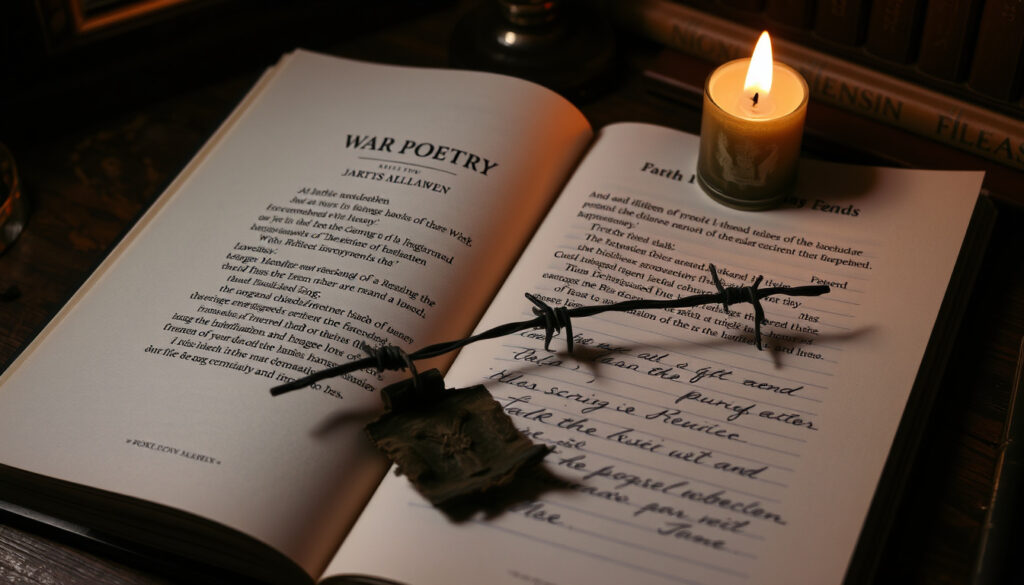
Wilfred Owen: Biography, Poems, and Lasting Legacy
Wilfred Owen (1893–1918) wrote some of the most powerful anti-war poetry from his experience in the trenches of World War I. His work, including “Dulce et Decorum Est” and “Anthem for Doomed Youth”, remains a stark reminder of the horrors of war.
Born 18 March 1893, Oswestry, Shropshire | Died 4 Nov 1918, Sambre-Oise Canal, France (aged 25) | Rank: Second Lieutenant | Poems published: 5 in lifetime, over 80 posthumously
Vital Stats at a Glance
- Born: 18 March 1893, Oswestry, Shropshire, England — Encyclopaedia Britannica
- Died: 4 November 1918, Sambre-Oise Canal, France (aged 25) — Poetry Foundation
- Military service: British Army, 2nd Manchesters, 1915–1918 — BBC Bitesize
- Poems published in lifetime: Only 5 (all in 1918) — Poetry Foundation
- Posthumous poems: Edited by Siegfried Sassoon, published 1920 — Encyclopaedia Britannica
- Famous works: “Dulce et Decorum Est,” “Anthem for Doomed Youth,” “Strange Meeting” — Poetry Foundation
- Enlisted: October 1915 — BBC Bitesize
- Front service: Western Front, January 1917 — Encyclopaedia Britannica
- Injury: Shell shock, sent to Craiglockhart June 1917 — Poetry Foundation
- Mentor: Siegfried Sassoon — The War Poets Association
- Total poems: Over 80 — Encyclopaedia Britannica
- Killed: 4 Nov 1918, one week before Armistice — Poetry Foundation
The Man Before the Mud: Early Life and the Road to War
Before he was the voice of a generation’s disillusionment, Wilfred Owen was just a bright, somewhat shy young man from Shropshire. He wasn’t a natural soldier; he was a bookish type who worked as a teaching assistant and studied botany from 1911 to 1913, according to the Encyclopaedia Britannica. When the war broke out in 1914, he was actually in France working as an English tutor, a world away from the trenches that would define his legacy, as noted by BBC Bitesize.
He enlisted in 1915, and it’s tempting to think he went with patriotic fervor. But the reality, as his poetry later showed, was far more nuanced. He was commissioned as a Second Lieutenant in the 2nd Battalion Manchester Regiment. The man who marched off was not the man who returned — if he returned at all.
The pattern: this early phase gave Owen the raw material that would later fuel his unflinching verse.
Shell Shock and Sassoon: The Crucible of Craiglockhart
By early 1917, Owen was in the thick of it. The experience broke something in him. He was diagnosed with shell shock — what we’d now call PTSD — and sent to Craiglockhart War Hospital in Edinburgh to recover. This was the turning point, not just for his health, but for his art. It was there he met Siegfried Sassoon, a fellow poet and soldier who became a mentor, a friend, and the midwife for Owen’s most powerful poems.
Sassoon didn’t just edit Owen’s drafts; he challenged Owen to write with raw, unflinching honesty. The result was a burst of creativity. While at Craiglockhart in 1917, Owen composed some of his most famous works, including “Anthem for Doomed Youth,” a powerful critique of the impersonal slaughter of war, as documented by the Poetry Foundation. This relationship is central to understanding Owen’s evolution; without Sassoon’s influence, the poems might have remained bitter, but they became something more — they became art.
The implication: without Sassoon, the poems might have lacked the controlled fury that gives them lasting impact.
Did Wilfred Owen suffer from PTSD?
Yes. In 1917 Owen was diagnosed with shell shock, the contemporary term for what is now recognized as post-traumatic stress disorder. He was treated at Craiglockhart War Hospital near Edinburgh. His poetry is deeply influenced by this trauma, and he was eventually graded as fit for service but chose to return to combat. BBC Bitesize confirms this diagnosis and its impact on his work.
Who was Wilfred Owen’s lover?
Owen met Siegfried Sassoon at Craiglockhart War Hospital in 1917. Sassoon became his close friend and literary mentor. Some biographers have speculated about a romantic relationship, but there is no conclusive evidence of a sexual relationship. Owen’s letters reveal deep emotional attachments to young men, but the exact nature of his relationship with Sassoon remains a subject of scholarly debate. The War Poets Association notes the friendship as a key influence on Owen’s work.
Futility and Fame: The Poems That Outlived Him
Owen’s poetic output is a study in quality over quantity. His poems range from the angry irony of “Dulce et Decorum Est” — which graphically describes a gas attack and calls the old lie that it’s sweet and fitting to die for one’s country — to the bleak, surreal landscape of “Strange Meeting.” These aren’t just poems; they are eyewitness testimony translated into verse. The Encyclopaedia Britannica notes that he is widely considered one of the greatest poets of the First World War, a sentiment echoed by the Poetry Foundation, which calls him a leading poet of the conflict.
For a poet who is now a staple of school curricula, it’s shocking to realize how little was published while he was alive. Only five of his poems appeared in print during his lifetime, all in 1918. The rest, over 80 poems in total, were curated and published posthumously by Sassoon in 1920. This delayed release meant his work arrived in the world with the weight of a ghost’s testimony, making his anti-war message resonate even more deeply in the years of bitter peace that followed.
What is Wilfred Owen’s most famous poem?
“Dulce et Decorum Est” is widely considered Wilfred Owen’s most famous poem. Written in 1917 and published posthumously in 1920, it portrays the horrific reality of a gas attack during World War I. The Latin title translates to “It is sweet and fitting,” a phrase from Horace that Owen calls “the old Lie.” The poem ends with the devastating lines “Dulce et Decorum est pro patria mori.” Poetry Foundation notes that this poem is often cited as a defining work of anti-war literature.
What are some of Wilfred Owen’s most famous poems?
In addition to “Dulce et Decorum Est,” Owen’s most famous works include “Anthem for Doomed Youth” (a sonnet mourning soldiers killed en masse), “Strange Meeting” (a dreamlike encounter with a dead enemy), “Exposure” (describing the physical and psychological suffering in winter trenches), and “Insensibility” (reflecting on the numbing of emotions in war). Encyclopaedia Britannica lists these as central to his canon.
How many poems did Wilfred Owen write?
Wilfred Owen wrote just over 80 poems. Only five were published during his lifetime. The majority were published posthumously in 1920, edited by Siegfried Sassoon. Poetry Foundation confirms the count of “over 80.”
The following table outlines Owen’s major works and their central themes.
| Work | Theme |
|---|---|
| “Dulce et Decorum Est” | The brutal reality of gas warfare vs. patriotic lies |
| “Anthem for Doomed Youth” | The lack of proper rites for soldiers killed en masse |
| “Strange Meeting” | A dream-like encounter with an enemy soldier in hell |
| “Futility” | The meaninglessness of death in the face of the sun’s indifference |
The pattern: each poem uses precise imagery to subvert the romantic ideals of war.
The catch: Owen’s technical skill and late innovation produced work that continues to shape literary responses to war.
Confirmed Facts vs. Rumor
Unlike many historical figures, Owen’s story is relatively well-documented, but that doesn’t mean there aren’t gaps and speculations.
What We Know for Sure
- He was born in Oswestry, Shropshire, in 1893, and worked as a teaching assistant before the war, per The War Poets Association.
- He served as a Second Lieutenant and was hospitalized for shell shock at Craiglockhart War Hospital in 1917.
- His mentor was Siegfried Sassoon, who edited his posthumous collection.
- He was killed in action on 4 November 1918, one week before the Armistice, according to Encyclopaedia Britannica.
What Remains Unclear or Speculative
- Some biographers speculate about the exact nature of Owen’s romantic relationship with Sassoon, though there is no conclusive evidence of a sexual relationship.
- The exact total count of his poems varies slightly by source, with most citing “over 80.”
- While his distrust of older leaders is clear, the precise formation of his political views during his time in France is a subject of scholarly debate.
- The specific circumstances of Owen’s shell shock diagnosis are not fully documented, leading to some historical debate about the timeline of his treatment.
The distinction between the documented facts and the softer speculation matters because it affects how we read the poems. If we view him purely as a victim, we miss his agency. If we view him as a hero, we miss his fragility. He was both.
Words from the Man Himself
Owen’s own letters and poems are the most powerful testament to his state of mind. They offer a raw, unfiltered look at the war from someone who lived it, hated it, and was destroyed by it.
“All a poet can do today is warn. That is why the true Poets must be truthful.”
— Wilfred Owen, from his draft preface, quoted in Poetry Foundation
“My subject is War, and the pity of War. The Poetry is in the pity.”
— Wilfred Owen, from his draft preface, cited by The War Poets Association
“Owen is widely recognized as one of the greatest war poets of the twentieth century.”
— Encyclopaedia Britannica
His words serve not only as art but as a warning — a purpose he explicitly stated. He saw his role not as a jingoist or a cheerleader, but as a truth-teller in a time of mass deception.
The Long Shadow: Why Owen Still Matters
Owen’s legacy is not just a matter of literary history; it’s the blueprint for how we process modern warfare. His poems have become shorthand for the futility of conflict, studied in schools and quoted in documentaries. The fact that he died so close to the end of the war — reportedly killed while trying to lead his men across a canal, as detailed by BBC Bitesize — makes his story unbearably tragic. It’s a bitter irony that the man who captured the waste of war became its final casualty.
His influence extends beyond the classroom. The honest, unromanticized view of combat that we see in films like “All Quiet on the Western Front” or the poetry of later conflicts owes a debt to Owen’s insistence on the “pity” over the “glory.” He refused to let the dead be just numbers; he made them individuals with names, faces, and fears.
For a parallel story of an artist who died young and left a profound legacy, see Nick Drake: Biography, Music, Death, and Lasting Legacy. Similarly, the impact of war on literary figures is explored in Roald Dahl: Biography, Family Tragedies & Medical Inventions.
The catch: Owen’s work forces readers to confront the reality that the most powerful anti-war statements are often written by those who never lived to see peace.
poets.org, mason.gmu.edu, poetseers.org, en.wikipedia.org, poemunity.com, poemhunter.com, bbc.co.uk, wilfredowen.org.uk, bbc.com
Frequently Asked Questions
Where was Wilfred Owen born?
He was born on 18 March 1893 in Oswestry, Shropshire, England, where his father worked as a railway clerk, according to The War Poets Association.
What caused Wilfred Owen’s death?
He was killed in action on 4 November 1918, while attempting to cross the Sambre-Oise Canal in France. He died just one week before the Armistice.
How many poems did Wilfred Owen publish in his lifetime?
Only five of his poems were published while he was alive, all appearing in 1918. His complete collection, edited by Siegfried Sassoon, was published posthumously in 1920.
Who was Siegfried Sassoon to Wilfred Owen?
Sassoon was a fellow soldier-poet whom Owen met at Craiglockhart War Hospital. He became Owen’s mentor, encouraging his poetry and editing his works after Owen’s death.
What is “Dulce et Decorum Est” about?
The poem graphically describes a gas attack during World War I. It satirizes the Latin phrase “dulce et decorum est pro patria mori” (“it is sweet and fitting to die for one’s country”), calling it “the old Lie.”
More related posts
 High Red Blood Cell Count: Causes, Symptoms & When to Worry
 Wall Mounted TV Unit: Weight, Cost & Safety Guide
 Blood Pressure Chart by Age and Gender: Normal Ranges
 Corey Gamble: Bio, Net Worth, and Career Facts
 Olivia Buzaglo: Age, Career, and Role at Premier League Productions
 Melanie Sykes Illness, Career Exit, and Gregg Wallace Controversy
 Can Dogs Eat Raspberries – Safety Benefits and Feeding Guide
