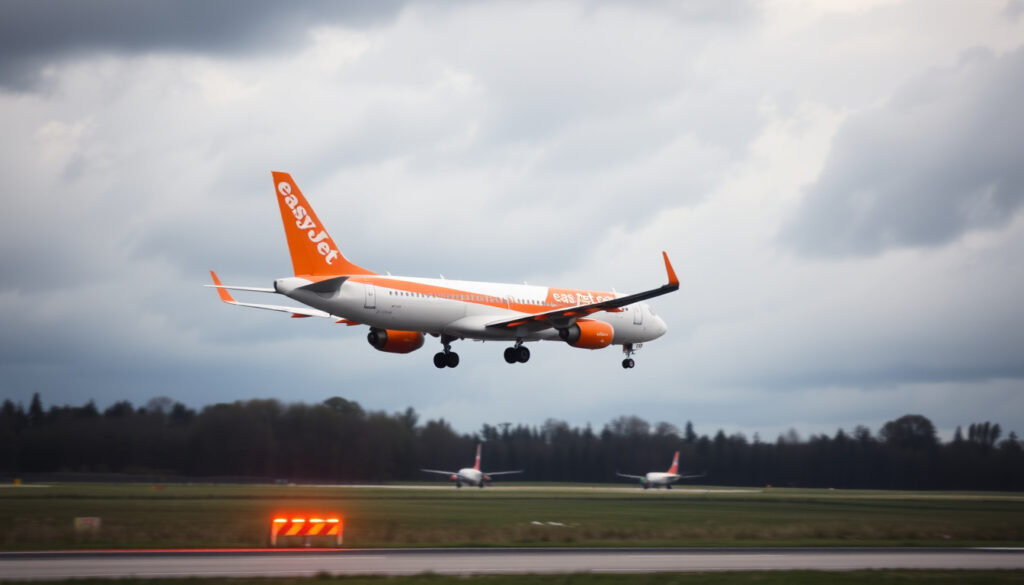
EasyJet Flight U22902 Emergency Landing: Munich Diversion
If you were on an evening flight from Cyprus to the UK last week, you might have noticed the plane circling somewhere over Germany instead of heading toward Bristol. EasyJet flight U22902 had declared an emergency and diverted to Munich, making a go-around before finally touching down in the early hours of October 23. It’s the second time in five months that this particular Paphos–Bristol route has forced a diversion.
Flight Number: U22902 · Aircraft: A320neo · Origin: Paphos, Cyprus · Intended Destination: Bristol, UK · Diversion Airport: Munich, Germany
Quick snapshot
- Exact technical cause of the emergency (Airlive)
- Passenger count for the Munich flight (Airlive)
- Whether EasyJet has issued a public statement for this incident (Airlive)
- Departed Paphos 21:30 EEST, October 22 (Airlive)
- Emergency declared while cruising at 38,000 ft (Airlive)
- 00:05 CEST: go-around; 00:09 CEST: landing (Airlive)
- Aircraft refueled in Munich, planned to resume journey to Bristol (Airlive)
- Investigation into the technical issue ongoing (Airlive)
- No official EasyJet statement directly quoted for this incident (Airlive)
The following table summarizes key data points from aviation tracking sources and news reports.
| Detail | Value |
|---|---|
| Date | 22 October 2025 |
| Flight | U22902 (A320neo, registration G-UZLW) |
| Route | Paphos (LCPH) to Bristol (BRS) |
| Diversion | Munich (EDDM) |
| Key Event | Go-around at 00:05 CEST, landing 26R at 00:09 CEST |
What happened with EasyJet flight U22902?
On the evening of October 22, 2025, EasyJet flight U22902 (also tracked as EZY2902) departed Paphos International Airport at 21:30 EEST, heading for Bristol, UK. The Airbus A320neo, registration G-UZLW, was cruising at 38,000 feet somewhere over Austria and Germany when the crew declared an emergency, transmitting squawk code 7700—the international distress signal—according to multiple aviation tracking sources.
The aircraft was vectored toward Munich Airport (MUC), where it conducted a flypast above runway 08L at 3,000 feet. At 00:05 CEST on October 23, the flight performed a go-around and repositioned for a second approach, this time to runway 26R. Touchdown occurred at 00:09 CEST, with the aircraft taxiing to the end of the runway and parking on a remote stand by 00:15 CEST. The airline confirmed the diversion and stated it planned to refuel before resuming the journey to the UK.
Flight route and declaration
The flight had been in the cruise phase when the technical issue prompted the emergency declaration. Squawk 7700 was transmitted while the A320neo was still over German airspace, alerting air traffic control to prioritize the aircraft for an immediate diversion.
Diversion to Munich
Munich Airport served as the nearest suitable runway capable of handling the A320neo. The crew’s decision to execute a go-around during the initial approach rather than attempt a direct landing reflects standard emergency protocol when an aircraft’s status requires assessment before a stable arrival.
Go-around procedure
A go-around during an emergency scenario means the pilots elected not to land on their first approach, likely to reposition for better alignment with runway conditions or to allow additional time for checklists. The aircraft then landed safely on runway 26R approximately four minutes after the go-around. The pattern here reflects pilots prioritizing caution over speed, a judgment that prevented a potentially unstable approach from becoming a hazard.
Has EasyJet ever had an emergency landing?
This is not the first time an EasyJet flight on the Paphos–Bristol corridor has required an emergency diversion. On June 15, 2025, flight EZY2902—later identified as the same flight number as the October incident—diverted to Izmir, Turkey, after passengers reported a smoke smell in the cabin. That event involved 169 passengers and occurred approximately 1 hour and 20 minutes after departure from Paphos, cruising at 36,000 feet. Emergency services met the aircraft upon landing, and passengers were provided hotel accommodation and meals before continuing on a replacement aircraft the following day.
The June incident prompted an EasyJet spokesperson to state that “the safety of our customers and crew is easyJet’s highest priority, and easyJet operates its fleet of aircraft in strict compliance with all manufacturers’ guidelines.” The airline also apologized for the inconvenience and thanked passengers for their understanding.
Recent smoke smell incident June 2025
The June diversion to Izmir remains the most closely documented EasyJet incident on this route. ITV News and The Independent both reported on the event, providing passenger accounts and the airline’s official response. This sets a baseline for comparing how the company handled the October Munich diversion, where no official EasyJet statement has been directly quoted in available sources.
Egypt mountain near-miss
Beyond these Cyprus-to-Bristol incidents, EasyJet has faced scrutiny over a separate near-miss event reportedly involving an Airbus A320 that flew too close to a mountain in Egypt. The Paphos–Bristol route’s pattern of diversions—including the October 2025 Munich event—suggests this corridor may present operational challenges, though aviation authorities have not confirmed a direct causal link.
Other diversions
Flight tracking data from FlightAware confirms that U22902 and EZY2902 are the same service, and historical records show this route has required multiple diversions within the same calendar year. The distinction between the Munich event (technical issue, go-around, refuel and resume) and the Izmir event (smoke smell, passenger care, replacement aircraft) illustrates how different triggers lead to different handling protocols. Travelers choosing this corridor should factor this pattern into their contingency planning.
Why did EasyJet U22902 divert to Munich?
The crew declared emergency due to a technical issue while the aircraft was cruising at 38,000 feet. Munich Airport was the nearest major facility capable of accommodating the A320neo, and the airline confirmed the diversion. The go-around above runway 08L at 3,000 feet appears to have been a deliberate pilot decision, likely to establish a stable approach on runway 26R rather than attempt an immediate landing while managing an in-flight issue.
Emergency declaration details
Squawk code 7700 triggers priority handling from air traffic control worldwide. When transmitted, the aircraft receives immediate vectors to the nearest suitable airport, and ground crews prepare for a possible emergency landing. In the Munich case, the crew received vectors to runway 08L for an initial assessment before electing to go around.
Flypast and go-around at 3,000 feet
A flypast at 3,000 feet allows controllers and emergency responders to visually assess the aircraft’s condition—checking for visible damage, landing gear status, or smoke—before the plane commits to landing. The go-around that followed suggests the crew wanted to reposition for runway 26R, which Airlive confirms was the final landing surface.
00:05 CEST update
By 00:05 CEST, the aircraft had turned around and initiated its final approach to runway 26R. Four minutes later, at 00:09 CEST, the A320neo touched down. The taxi to the end of the runway and parking on a remote stand by 00:15 CEST indicates precautionary handling—remote stands allow emergency services to stage at a safer distance while ground crews assess the aircraft. This positioning gave responders clear access without disrupting active runway operations.
How common are emergency landings and aborted landings?
Emergency diversions are uncommon but not rare in commercial aviation. Aborted landings—sometimes called go-arounds—occur more frequently, often due to weather, traffic conflicts, or aircraft issues like those on U22902. Aviation safety data indicates that go-arounds happen in roughly 0.5% of all landings industrywide, though most occur in non-emergency contexts.
Aborted landing frequency
A go-around during a declared emergency is rarer than a standard go-around, but the procedure itself is well-trained. Pilots practice go-arounds regularly, and the decision to execute one rather than land immediately often reflects conservative safety judgment rather than a sign of worsening conditions.
Airline safety records
EasyJet has not experienced a crash in its operating history—a distinction shared by several European carriers. The airline’s safety record, combined with regulatory oversight from the UK Civil Aviation Authority, means that diversion events, while disruptive, are handled within established safety frameworks.
EasyJet precedents
Two diversions on the same route within five months is notable, but without official investigation reports, drawing conclusions about underlying causes remains speculative. What is clear is that the Paphos–Bristol corridor has shown a pattern requiring contingency planning, and the airline has successfully managed both events without passenger injury. The carrier’s ability to resolve consecutive emergencies without serious incident demonstrates established safety protocols functioned as intended.
What is the current status of EasyJet flight U22902?
As of available reports, the aircraft refueled in Munich following the landing at 00:09 CEST on October 23, 2025. The airline confirmed plans to resume the journey to Bristol, though the exact continuation time has not been publicly documented. FlightAware’s tracking data remains available for historical reference on the flight’s movements.
Post-diversion outcomes
Unlike the June Izmir diversion—where passengers received hotel accommodation and a replacement aircraft—the Munich event appears to have been managed with an in-situ solution. The decision to refuel and continue on the same aircraft suggests the technical issue, while serious enough to warrant an emergency declaration, did not prevent the plane from completing its mission.
Passenger reports
Passengers reportedly experienced a sudden descent during the emergency phase, according to Travel and Tour World. No injuries have been reported, but passenger accounts of the go-around and the extended diversion remain limited in publicly available sources.
EasyJet response
An official EasyJet statement for the October Munich incident has not been directly quoted in available sources, unlike the June Izmir event where a spokesperson provided comment. This gap in the public record leaves questions about what specific technical issue prompted the emergency and what customer care, if any, was offered. The absence of direct attribution means readers must rely on third-party aviation trackers for verification.
Confirmed
- Diversion to Munich Airport
- Go-around executed above runway 08L
- Landing on runway 26R at 00:09 CEST
- No crash or passenger injury reported
- Same flight number (EZY2902) involved in June Izmir diversion
Unclear
- Exact technical cause of the emergency
- Passenger count for the Munich flight
- Whether EasyJet has issued a public statement
- Final arrival time in Bristol after refueling
- Official investigation outcomes from aviation authorities
The safety of our customers and crew is easyJet’s highest priority, and easyJet operates its fleet of aircraft in strict compliance with all manufacturers’ guidelines.
— EasyJet spokesperson, ITV News (regarding the June 2025 Izmir incident)
We would like to thank customers for their understanding and apologise for the inconvenience caused.
— EasyJet spokesperson, ITV News
Two diversions in five months on the same route is a pattern worth watching. For frequent flyers on the Paphos–Bristol corridor, checking your airline’s contingency protocols before booking may save some anxiety if the unexpected happens mid-flight.
For travelers booked on future Paphos–Bristol services, the October diversion adds a data point to an already disrupted route. EasyJet has managed both emergencies without serious injury, but the absence of a public statement for the Munich event leaves passengers without official reassurance about what went wrong and what safeguards apply going forward. Checking flight status before departure and understanding your airline’s compensation rights in the EU remain practical steps.
Related reading: Ibis Budget Manchester Airport · Manchester to London Train
flightaware.com, aviationsourcenews.com, travelandtourworld.com
EasyJet’s U22902 diversion to Munich echoes the full incident breakdown that covered two prior flights forced there by passenger disruptions in 2024.
Frequently asked questions
Which country owns Ryanair?
Ryanair is an Irish airline headquartered in Dublin, Ireland. It is publicly traded on the NASDAQ and London Stock Exchange, with the largest shareholder historically being Ryan Holdings, controlled by founder Michael O’Leary.
Who owns EasyJet?
EasyJet plc is a publicly listed UK airline headquartered at London Luton Airport. It trades on the London Stock Exchange and is subject to UK regulatory oversight, with institutional shareholders comprising the majority of ownership.
What’s the salary of an EasyJet pilot?
EasyJet pilot salaries vary by rank and experience, with first officers typically earning between £50,000 and £80,000 annually, while captains can earn £120,000 or more. Specific figures depend on contracts, flying hours, and tenure.
Can I take a pair of tweezers in my hand luggage?
Yes, tweezers are generally permitted in hand luggage under most airline and airport security regulations, including those in the UK and EU. However, sharp objects that could be used as weapons may be restricted, so checking your specific airline’s policy before traveling is advisable.
Which airline has never had a crash?
Several airlines, including EasyJet, have never experienced a fatal crash in their operating history. Safety records are tracked by organizations like the Aviation Safety Network, and EasyJet’s record is notably clean despite the 2025 diversions.
What EasyJet flight nearly crashed into a mountain in Egypt?
Reports have surfaced regarding an EasyJet flight that allegedly flew too close to a mountain in Egypt. Aviation safety investigations are typically conducted by national authorities, and details of such near-miss events are often released months or years after the incident.
How common are plane emergency landings today?
Emergency landings occur in a small fraction of commercial flights—statistically less than 1% of all flights involve any type of diversion or emergency response. Most are resolved without injury, and modern aircraft are designed to handle a wide range of in-flight issues safely.
What is EasyJet flight status checker?
EasyJet offers an online flight status tool on its website and app, allowing passengers to track departures, arrivals, and any delays or cancellations. Flight tracking platforms like FlightAware also provide real-time data for EasyJet flights.
More related posts
 Harry Potter Train Scotland 2026: Jacobite Steam Guide
 Free Energy Saving Gadgets – UK Eligibility and Savings Guide
 When Is Full Moon? 2026 Dates, Ireland Times & Calendar
 Mark Williams Snooker: Career, Family & 2026 Facts
 Leah Shutkever: From Bromsgrove to 40 World Records
 What Is Net Zero? Simple Explanation, Examples & UK Target
 Milla Jovovich: Biography, career, family, and recent news
 Merry Christmas and Happy New Year: The Facts Behind Greetings
